





























Sea fish
Knout goby
Mesogobius batrachocephalus
Get to know the species, pick your region, find your spot.
Choose your region
Romania · Black SeaThe information changes with the region you choose.
Where is Knout goby caught?
Explore the regions or go straight to the map.
Black Sea fishing spots
13- Capul Buival Tulcea · Sfântu Gheorghe
- Capul Tuzla Constanța · Tuzla
- Constanta South Breakwater Constanța
- Digul Luminița (ECN2) Constanța · Eforie
- Digul Van Oord (ESN 4) Constanța · Eforie
- Far intrare Mangalia Constanța · Mangalia
- Farul Sulina Tulcea · Sulina
- Farul vechi Constanța
No fishing ground or region matches your search.
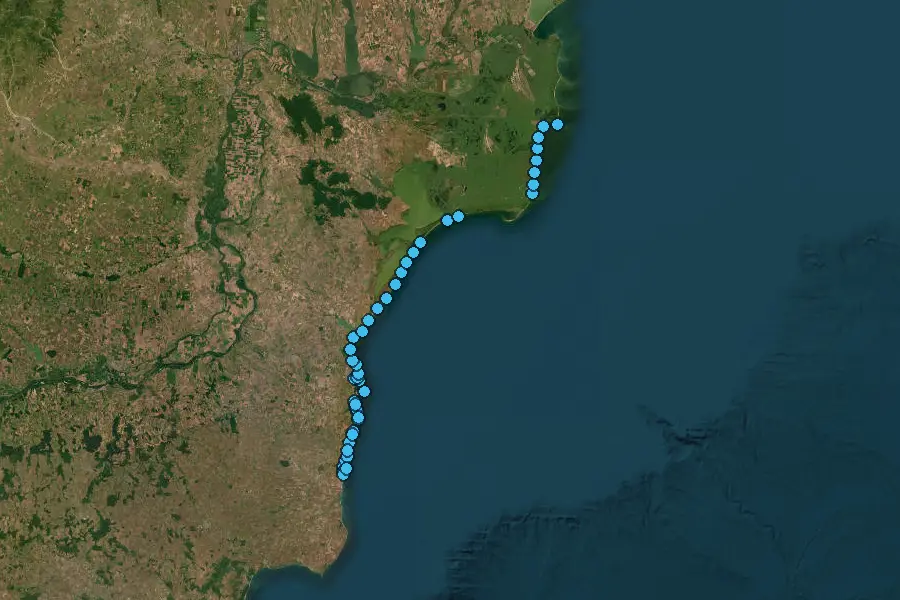
A listed spot is not a guarantee of a catch.
Black Sea
Season and suitable conditions
Check the season information for the region you chose.
Peak months: Apr, May, Jun, Jul, Aug
Season information is no guarantee of a catch.
Best spots in November
By month
Average monthly score of the spots in Turkey (0–100).
- 69 Jan
- 69 Feb
- 80 Mar
- 79 Apr
- 69 May
- 15 Jun
- 15 Jul
- 15 Aug
- 15 Sep
- 51 Oct
- 69 Nov
- 65 Dec
The best spot in each Turkish province, by this month’s score.
- Durusu Karaburun Arka Deniz Arnavutköy, İstanbul 74/100 Very good
- Beğendik Köyü Breakwater NW Demirköy, Kırklareli 74/100 Very good
- Kastro Plajı Saray, Tekirdağ 74/100 Very good
- Abana Limanı Kıyısı Abana, Kastamonu 73/100 Very good
- Bağırganlı Plajı Kandıra, Kocaeli 73/100 Very good
A 0–100 score from season, water temperature, habitat and local records; a general trend, not a guarantee.
Best times of day
When in the day it bites best, month by month.
- Active by day
- Poor at night
In November
-
Dawn Best 80
0.5 h before sunrise → 2.5 h after
-
Midday 70
1 h before midday → 2 h after
-
Dusk 75
2.5 h before sunset → 0.5 h after
Not productive at night
Moon phase
Effect of the moon on night fishing; the scores compare the phases.
- New moon 15
- First quarter 15
- Full moon 20
- Last quarter 15


Best phase: No clear effect
Windows across 12 months
| Best times of day | JJan | FFeb | MMar | AApr | MMay | JJun | JJul | AAug | SSep | OOct | NNov | DDec |
|---|---|---|---|---|---|---|---|---|---|---|---|---|
| Dawn | 50 | 50 | 75 | 75 | 75 | 85 | 85 | 85 | 80 | 80 | 80 | 50 |
| Midday | 85 | 85 | 70 | 70 | 70 | 50 | 50 | 50 | 70 | 70 | 70 | 85 |
| Dusk | 60 | 60 | 75 | 75 | 75 | 80 | 80 | 80 | 75 | 75 | 75 | 60 |
| Night |
Windows follow sunrise and sunset; clock times change with place and date. Scores are relative within the month: 100 is the best window of the day.
6 sources · confidence low
Habitat
Where it lives and in what kind of water: ranges compiled by the research.
Depth
0–100 m
mostly 20–60 m
Water temperature
4–18 °C
ideal 10–15 °C
Salinity
Also enters brackish water
0–20 ‰
Shore types
- Cove / inner bay
- Rocky shore
- Breakwater / jetty
- River / stream mouth
- Lagoon / weir mouth
- Cliff / steep shore
- Harbour mouth
- Reclaimed shore
Bottom
Lives close to the bottom
- Sand
- Rock
- Sand, gravel and rock
Ranges from FishBase, AquaMaps and the literature; a general tendency, not a hard limit.
Confidence: shore type high, temperature low
Bait and tackle suggestions
Recorded baits and fishing techniques.
Bait by month
Baits documented for shore fishing, month by month and by water clarity.
In November
Processed bait (all year)
- Chicken
- Beef
By water clarity
Rock / bottom omnivore — Picks up crustaceans, worms and weed. Wary; relies on smell and a natural look.
- Clear Visibility: over 8 m
- Natural first, lures also work First natural bait: Ragworm · Very suitable Usually in this water: Live shrimp, tube worm, mud shrimp, mussel; thin line, small hidden hook; little chum. First lure: Jighead + soft worm · Very suitable Usually in this water: LRF micro soft plastic, imitation shrimp; very small, slow. Colour: Clear, Natural brown, Red
- Slightly coloured Visibility: 4–8 m
- Natural first, lures also work First natural bait: Ragworm · Very suitable Usually in this water: Shrimp, worm, mussel; normal pieces. First lure: Jighead + soft worm · Very suitable Usually in this water: LRF/micro soft plastic, imitation shrimp. Colour: Pink, White, Red
- Moderately coloured Visibility: 2–4 m
- Natural bait First natural bait: Ragworm · Very suitable Usually in this water: Mussel, crab, sardine pieces with chum (crushed mussel or bread). First lure: Jighead + soft worm · Suitable Usually in this water: Scented soft plastic (Isome/Gulp type); slow, on the bottom. Colour: Fluorescent, Pink
- Murky Visibility: 1–2 m
- Natural bait First natural bait: Anchovy · Suitable Usually in this water: Crab, mussel, razor clam; bottom rig; strong scent. First lure: Jighead + soft worm · Weak Usually in this water: Weak; scented soft plastic only. Colour: Fluorescent, Dark silhouette, Red
- Very murky Visibility: under 1 m
- Natural bait First natural bait: Anchovy · Suitable Usually in this water: Mussel, crab, cut bait; big pieces. First lure: Jighead + soft worm · Not recommended
12-month bait calendar
- January
- Natural baits: Mussel, Shrimp, Anchovy, Ragworm Lures: Jighead + soft worm, LRF micro soft plastic
- February
- Natural baits: Mussel, Shrimp, Anchovy, Ragworm Lures: Jighead + soft worm, LRF micro soft plastic
- March
- Natural baits: Mussel, Shrimp, Anchovy, Ragworm Lures: Jighead + soft worm, LRF micro soft plastic
- April
- Natural baits: Mussel, Shrimp, Anchovy, Ragworm Lures: Jighead + soft worm, LRF micro soft plastic
- May
- Natural baits: Mussel, Shrimp, Anchovy, Ragworm Lures: Jighead + soft worm, LRF micro soft plastic
- June
- Natural baits: Mussel, Shrimp, Anchovy, Ragworm Lures: Jighead + soft worm, LRF micro soft plastic
- July
- Natural baits: Mussel, Shrimp, Anchovy, Ragworm Lures: Jighead + soft worm, LRF micro soft plastic
- August
- Natural baits: Mussel, Shrimp, Anchovy, Ragworm Lures: Jighead + soft worm, LRF micro soft plastic
- September
- Natural baits: Mussel, Shrimp, Anchovy, Ragworm Lures: Jighead + soft worm, LRF micro soft plastic
- October
- Natural baits: Mussel, Shrimp, Anchovy, Ragworm Lures: Jighead + soft worm, LRF micro soft plastic
- November
- Natural baits: Mussel, Shrimp, Anchovy, Ragworm Lures: Jighead + soft worm, LRF micro soft plastic
- December
- Natural baits: Mussel, Shrimp, Anchovy, Ragworm Lures: Jighead + soft worm, LRF micro soft plastic
This is the usual pattern; the water and weather on the day can change it. Colour is fine-tuning: bait type, size and action come first. Confidence: natural medium, lures high. Colour and presentation guide
Fishing rules
The regulation holds no separate minimum size or closed season entry for this species. The provisions for Türkiye as a whole apply.
Before you go, check local area and method restrictions.
Species profile
- Scientific name
- Mesogobius batrachocephalus
- Water type
- Saltwater
- Other names
- Knout goby
Frequently asked questions
Which seas is Knout goby found in?
In our records Knout goby appears in these seas: Black Sea — Romania.
In which months is Knout goby at its peak?
Peak periods by sea: Black Sea — Romania April–August.
Similar species