



























4 min read
When and how do you catch Atlantic horse mackerel?
Atlantic horse mackerel is marked productive January to December in all four seas, so it has no season. Tackle, the two species and the 12 and 13 cm minimum sizes.
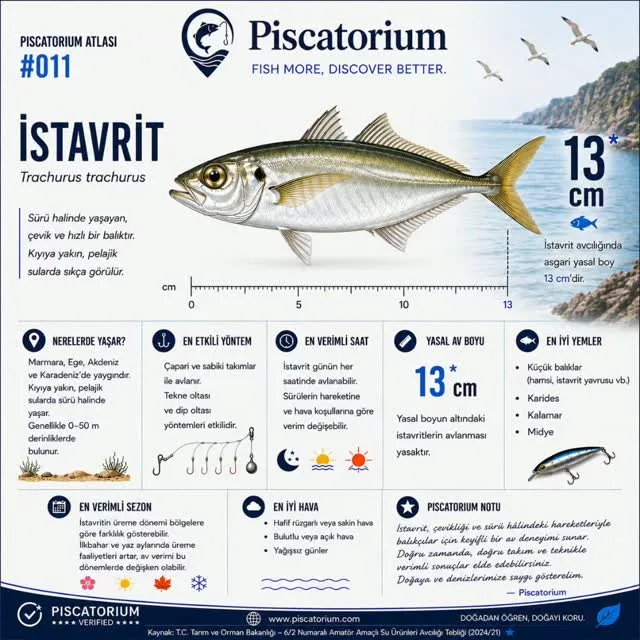
In our catalogue, horse mackerel is recorded year-round in all four Turkish seas; it is a shore fish that doesn't require waiting for a season. The recorded main bait is the feathered sabiki rig, and for natural bait shrimp and pieces of anchovy; the techniques are sabiki and LRF. Two species go by this name: Atlantic horse mackerel (Trachurus trachurus) and Mediterranean horse mackerel (Trachurus mediterraneus).
Two horse mackerels: Atlantic and Mediterranean
Both species belong to the Carangidae family and look very much alike. Their shared mark is the large, bony plates lined up along the lateral line; this "armour" is what sets horse mackerel apart from other shore fish. In our catalogue, the local names of the Atlantic horse mackerel are istavrit and karagöz istavrit; those of the Mediterranean horse mackerel are sarıkuyruk istavrit and Akdeniz istavriti.
The known way to tell the two apart is to look at the thin accessory line that runs above the main lateral line on the back: in the Atlantic horse mackerel this line extends further back, to the end of the second dorsal fin; in the Mediterranean horse mackerel it ends further forward. The tail of the Mediterranean horse mackerel is also often yellowish. Making out this detail on the shore isn't always easy; if you can't be sure about a fish, go by the higher limit, that is, 13 centimetres.
The name trap: karagöz and sarıkuyruk are other fish too
Both names of the horse mackerel overlap with the name of another species. "Karagöz" on its own means Diplodus vulgaris of the Sparidae family, the Common two-banded seabream; its limit is 18 centimetres. "Sarıkuyruk" on its own is the Greater amberjack, a large predator related to the leerfish, Seriola dumerili: 30 centimetres, 1 fish per day, and closed from 15 April to 15 May. That is why the word "istavrit" at the end matters; when you look into your bucket, think of which fish is meant by its scientific name.
Minimum legal size: the 2026/26 amendment
The rule for horse mackerel changed in autumn 2026. In the earlier text of the communiqué, the limit for both species was 13 centimetres. The amendment no. 2026/26, published on 16 September 2026, lowered the limit for the Atlantic horse mackerel to 12 centimetres; the Mediterranean horse mackerel stayed at 13 centimetres.
| Species | Scientific name | Minimum size | Daily quantity | Closed season |
|---|---|---|---|---|
| Atlantic horse mackerel | Trachurus trachurus | 12 cm (previously 13) | 5 kg | Not specified |
| Mediterranean horse mackerel | Trachurus mediterraneus | 13 cm | 5 kg | Not specified |
For both species the communiqué has no species-specific seasonal ban; the provisions on areas and methods apply year-round. The quantity limit is counted by weight: with horse mackerel, where a lot of fish can come in a short time on a sabiki, 5 kilograms fills up faster than you'd think. The figures come from amateur fishing communiqué no. 6/2; the official communiqué is the binding one, so check the current publication before you go fishing. The values for all species are on the legal fish sizes page.
Where: almost the whole coast
Horse mackerel is recorded in the large majority of the Turkish sea and coastal spots in our catalogue. The recorded habitat is "pier and open water", and its catchability from shore is "high". The Atlantic horse mackerel is recorded in a total of 1,387 fishing spots across the four seas; the breakdown sea by sea, together with the catalogue's total number of spots in that sea, is as follows:
- Marmara — in 388 of 398 spots (Mediterranean horse mackerel 294)
- Black Sea — in 372 of 392 spots (Mediterranean horse mackerel 372)
- Aegean — in 353 of 377 spots (Mediterranean horse mackerel 353)
- Mediterranean — in 274 of 295 spots (Mediterranean horse mackerel 274)
The two species are recorded in the same number of spots in the Black Sea, the Aegean and the Mediterranean; the difference shows up only in Marmara. At province level, the place where the Atlantic horse mackerel is recorded most is İstanbul: 208 spots. It is followed by Antalya with 170, Muğla with 135, Çanakkale with 126, İzmir with 94 and Balıkesir with 85 spots. For the Mediterranean horse mackerel the numbers are 189 in İstanbul, 115 in Çanakkale and 66 in Balıkesir; in the other three provinces they are the same.
When: recorded year-round
In the rows for all four seas, all twelve months are marked as productive; both species are recorded year-round. You don't need to pick a month; what needs picking is the time of day. General angling lore describes horse mackerel as a fish of dusk and night: toward sunset it comes close to shore, and at night it chases the small creatures that gather under pier lights. Read this not as a rule, but as a hint to keep in mind when choosing your departure time.
With what: sabiki and LRF
In the rows for all four seas, the main bait is "feathered sabiki" and the technique is "sabiki". Besides the sabiki, LRF is also recorded as a general fishing technique; for artificial bait, sabiki and micro jig, and for natural bait, shrimp and pieces of anchovy. The regional supporting baits for the Atlantic horse mackerel vary by sea: in Marmara, European anchovy, horse mackerel and shrimp; in the Black Sea, European anchovy and European sprat; in the Aegean, European sardine, mamun and sülünez; in the Mediterranean, European sardine, European squid and shrimp.
A sabiki consists of short branch lines strung along a main body and the feathered or shiny hooks on them; at the very bottom there is a sinker. The rig is dropped into the water and worked up and down with short jerks. LRF, on the other hand, is a more selective method done with a light rod, thin line and silicone or a micro jig fitted on a small jig head. If small horse mackerel come often on the sabiki, you need to go up one hook size and measure every fish against 12 or 13 centimetres before putting it in the bucket.
The right fish for a beginner
Being recorded year-round, easy to reach from shore and catchable with a simple rig makes horse mackerel a suitable target for those just starting out in angling. A pier, a short rod and a few sabikis are enough for a first try. This ease has a cost too: small fish come just as easily.
That is why the most useful habit with horse mackerel is measuring. Drawing two lines on the edge of the bucket showing 12 and 13 centimetres is faster than pulling out a tape measure for every fish. Handling a fish under the limit with a wet hand and releasing it into the water after removing the hook quickly improves its chance of survival.
All the records, sea by sea, are on the horse mackerel species page; the record for the Mediterranean horse mackerel is also kept separately on the Mediterranean horse mackerel page.