































4 min read
Gilthead seabream: when, what bait, and minimum size in cm?
Gilthead seabream is recorded all year in Marmara, the Aegean and the Mediterranean. 861 fishing spots, recorded baits and the 20 cm minimum legal size.
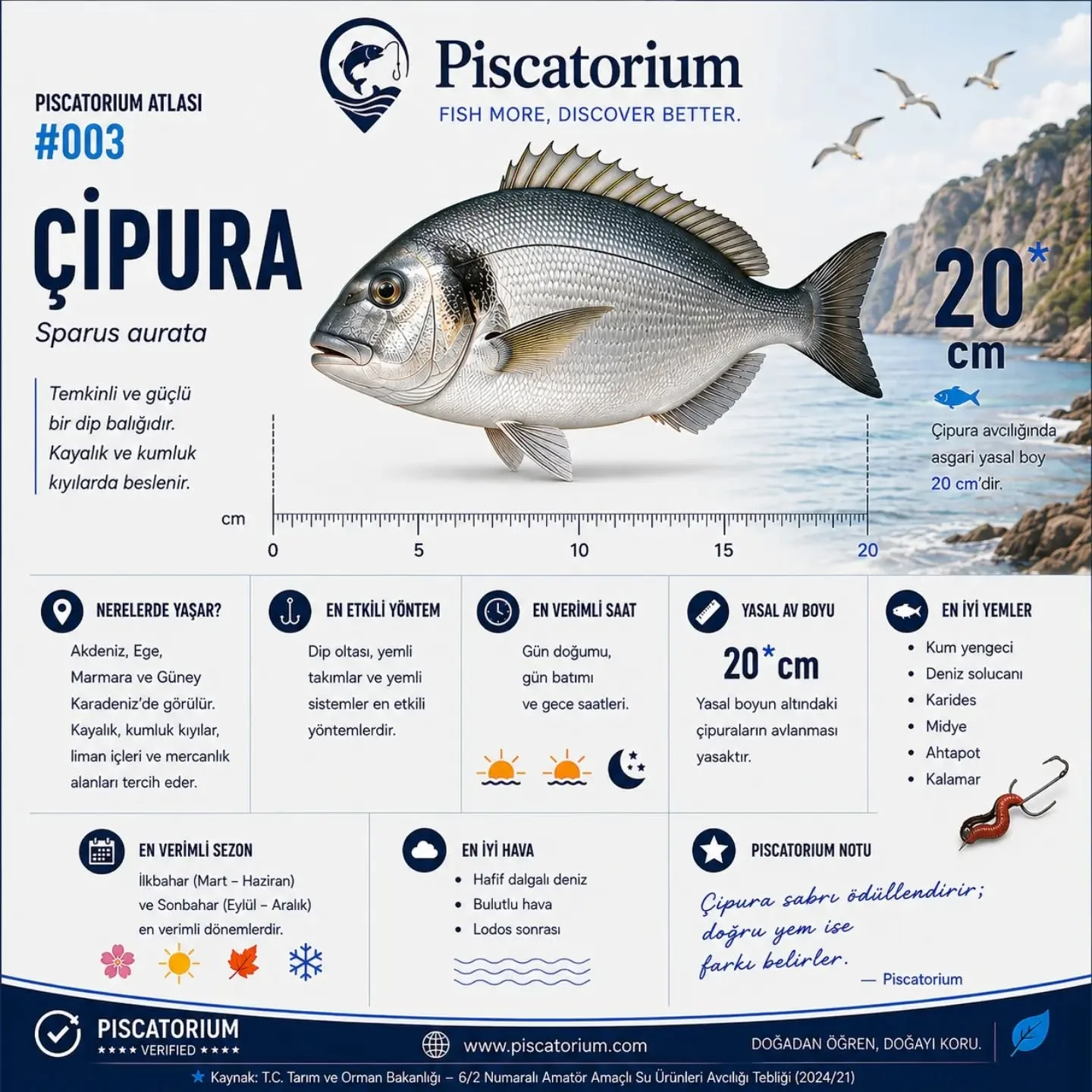
Gilthead seabream (Sparus aurata) is recognised by the golden band between its eyes and is one of the familiar sparids of shore fishing. In our catalogue it is recorded in the Marmara, Aegean and Mediterranean; there is no Black Sea row, and in all three seas all twelve months are marked as productive. The minimum legal size is 20 centimetres.
When: recorded year-round, but not every month is the same
In all three rows, Marmara, Aegean and Mediterranean, every month from January to December is marked; in our catalogue the gilthead seabream is recorded year-round. The calendar has no opening or closing month for this species, and the communiqué contains no closed season specific to it.
Even so, what you see on the shore changes with the seasons. As general fishing knowledge, the gilthead seabream moves close to shallow sandy flats, lagoons and river mouths in the warm months; as the water cools it retreats to deeper, calmer water. The day after rough weather, the murky strip along the beach brings the gilthead seabream close to shore, because it exposes the shelled creatures churned up from the bottom. Autumn is the season anglers most often talk about the gilthead seabream. That does not come from the monthly table but from the general experience of shore fishing; even within the same month, water temperature and clarity change the outcome. For the values to check before heading out, the article which three numbers to check before going out to sea is a good place to start.
Golden forehead, dark spot: recognising the gilthead seabream
The gilthead seabream has a deep, oval body that is flattened from the sides, silvery-grey in colour. The most distinctive mark is the golden-yellow band running between the two eyes; this is what gives the fish names meaning “golden forehead” in other languages. There is a dark spot at the upper corner of the gill cover, and thin lengthwise lines can be made out along the flanks. The jaws are strong and the back teeth are crushing teeth: the gilthead seabream feeds by breaking shelled creatures. In our catalogue its local names are “Çipura” and “Çupra”.
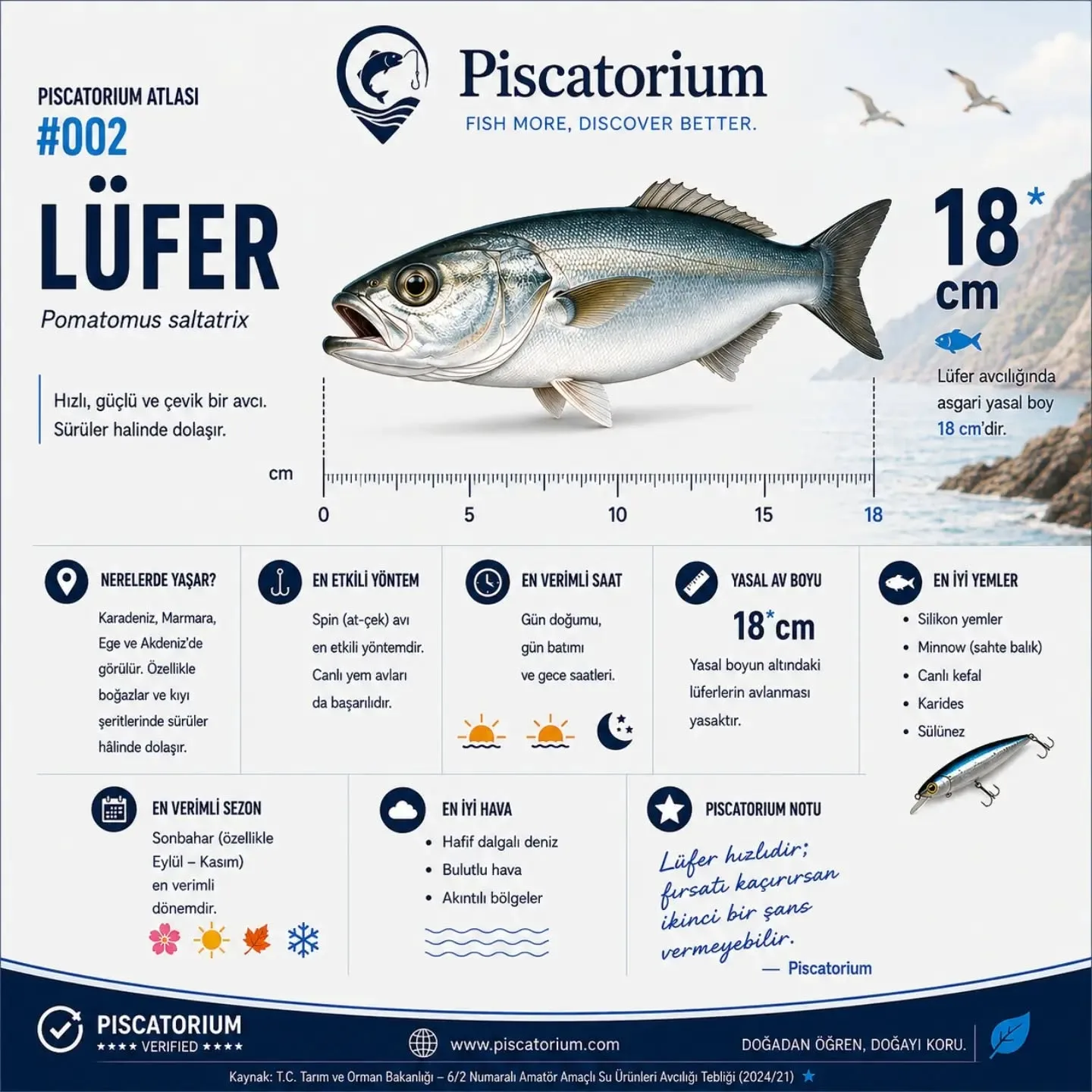
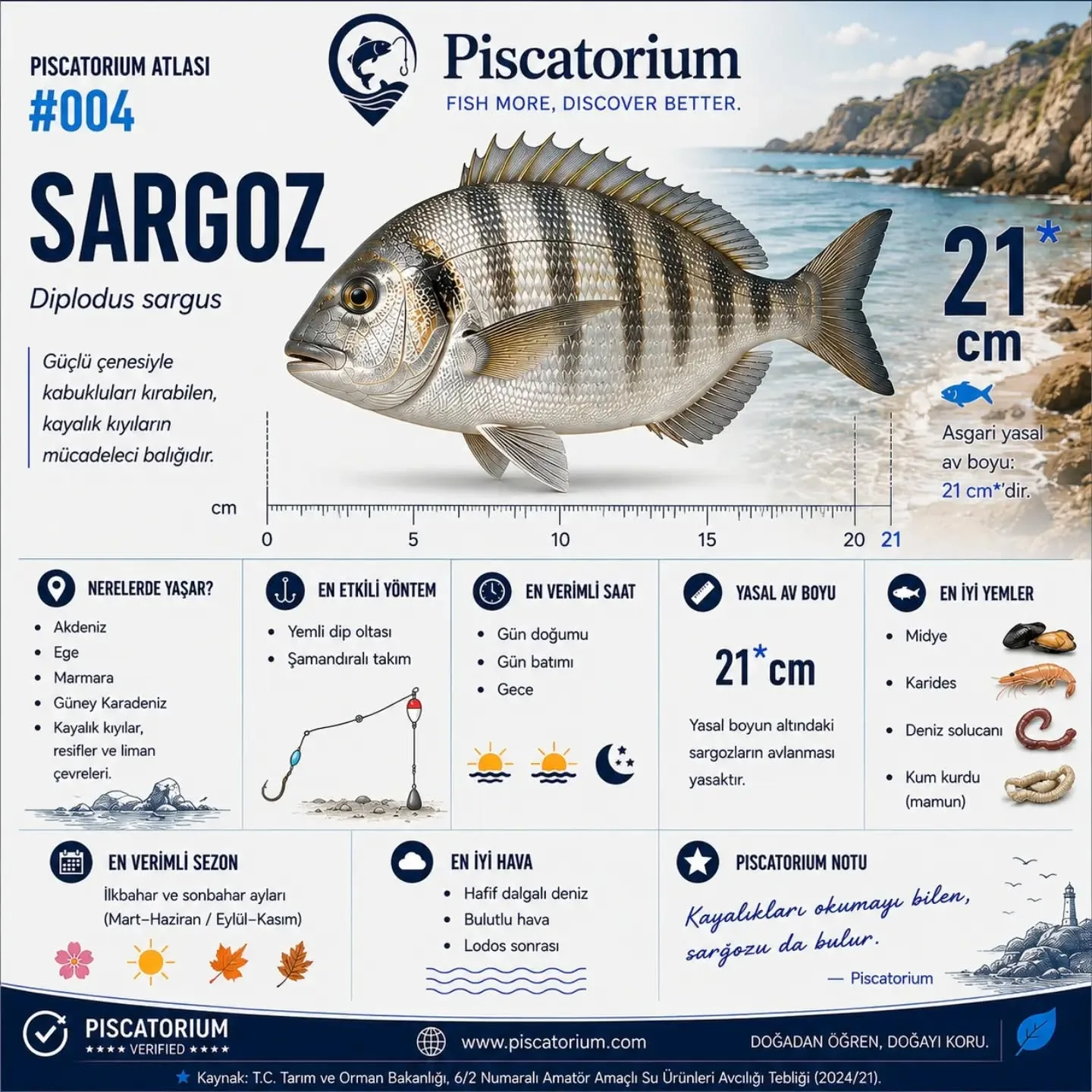
On the shore it can turn up alongside the white seabream and the common two-banded seabream, which belong to the same family. The white seabream has vertical lines on its flanks, and the common two-banded seabream has two dark bands on its nape and tail base; the gilthead seabream has neither pattern, while the forehead band is found only on it. The limits of the three species differ: 20 for the gilthead seabream, 21 for the white seabream, 18 for the common two-banded seabream.
861 spots across three seas
Along the Turkish coast, the gilthead seabream is linked to a total of 861 spots in our catalogue: Aegean 319, Marmara 302, Mediterranean 240. The ratios make its prevalence clearer: the gilthead seabream is recorded at 319 of the 377 Aegean spots in our catalogue, 302 of the 398 Marmara spots and 240 of the 295 Mediterranean spots. What is measured here is not abundance but prevalence: at how many spots there is a record.
The ranking by province is spread across the three seas: Antalya 151, İstanbul 150, Muğla 135, Çanakkale 97, İzmir 83, Balıkesir 57. There is only a one-spot difference between Antalya on the Mediterranean and İstanbul on the Marmara; the gilthead seabream is linked to almost the same number of spots on two very different coasts. The recorded habitat is sandy and rocky shore, and shore-fishing accessibility is “high”: beaches reachable on foot, rocky transitions and harbour interiors are this species’ territory. The recorded environment is sea and brackish water; this is why lagoons and river mouths, where salinity drops, also enter gilthead seabream territory.
The empty Black Sea row does not mean the gilthead seabream is never seen there, only that the catalogue carries no record for that coast.
Bait: lugworm, ragworm, crab, mussel
The species record lists lugworm, ragworm, crab and mussel as natural bait, and silicone worm and small jig as artificial lures. There are three headings in the fishing-technique field: bottom, surf and LRF. Going down to the sea rows, the technique in all three seas is surf casting, and the standout bait is ragworm.
Each sea has its own list of supporting baits: in the Marmara, European anchovy, Atlantic horse mackerel and shrimp; in the Aegean, European sardine, lugworm and ragworm; in the Mediterranean, European sardine, European squid and shrimp. Crab and mussel appearing on the list fits the fish’s teeth; worm baits, meanwhile, target the gilthead seabream as it combs the bottom along the beach. Lugworm and ragworm are threaded along the length of the hook; the point of the hook should stay inside the bait, while the curling tip gives the fish a natural movement.
Surf on the beach, light tackle on the rocks
For surf casting on the beach, the usual setup is a long rod, a lead that stays fixed on the bottom and a long leader; the bait should land just beyond the strip where the waves stir up the sand. The gilthead seabream first crushes and tests the bait in its mouth, so the first tremor at the rod tip is often not a real bite. A strike made in a hurry wastes the bait; you need to wait for the fish to take the bait and move away.
On a rocky shore, a lighter bottom rig or LRF with a silicone worm is dragged slowly through the sandy gaps in front of the rocks. The fish is strong; checking the line and knots before every cast reduces losses.
When you bring a gilthead seabream ashore, watch out for the hard spines of the dorsal fin; folding the fin back as you grip it protects your hand. If its length is close to the limit, do not put it in the bucket without measuring. Handle a fish under 20 centimetres with a wet hand, remove the hook without forcing it and release it; if the hook is deep, cutting the line short does less harm than struggling to pull it out.
Size and quantity
| Species | Minimum size | Daily limit | Closed season |
|---|---|---|---|
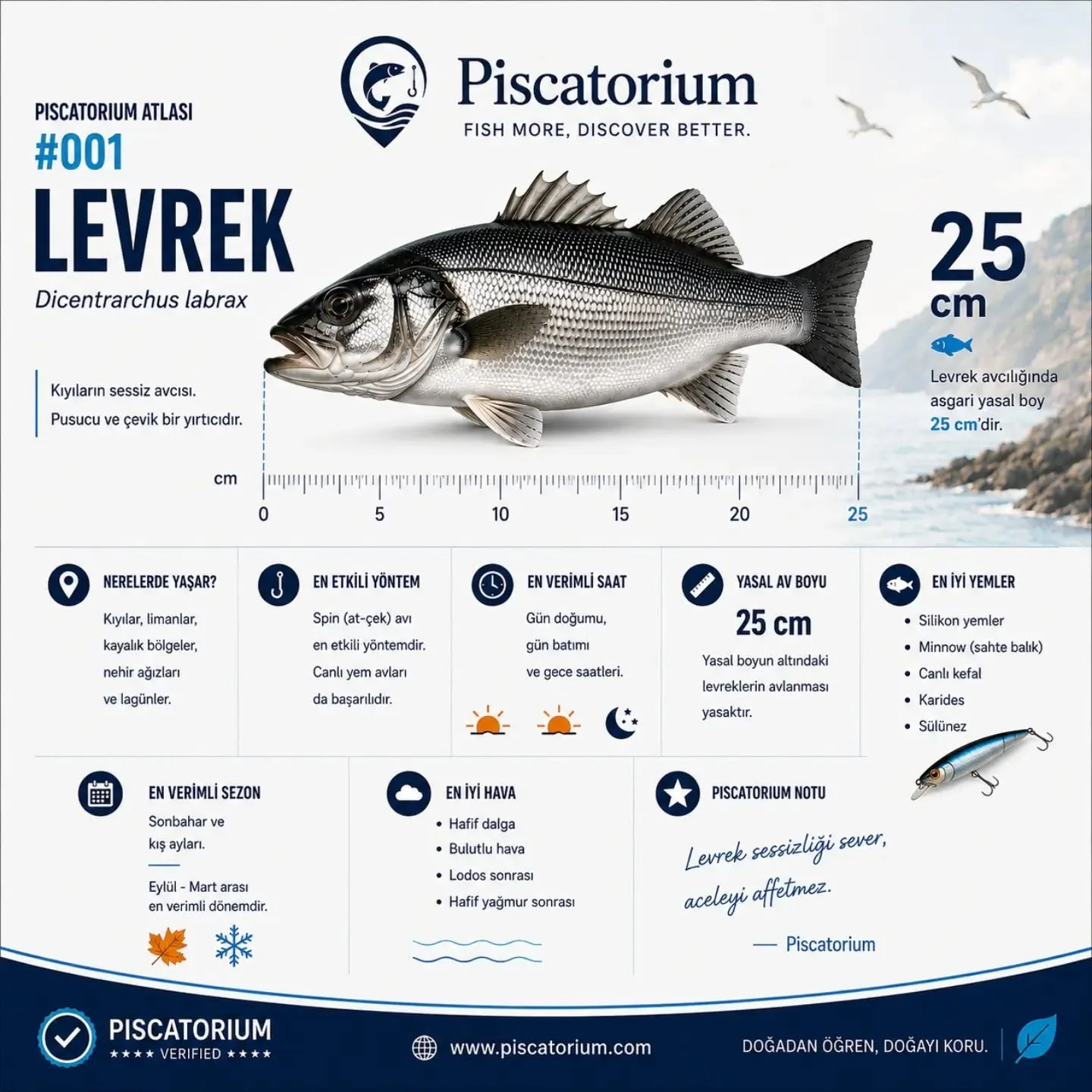
| Gilthead seabream | 20 cm | 5 kg | — |
| White seabream | 21 cm | 5 kg | — |
| Common two-banded seabream | 18 cm | 5 kg | — |
| European seabass | 25 cm | 5 kg | — |
Basis: recreational fishing communiqué no. 6/2, 2024/21 Table 7. No species-specific closed season is stated for the gilthead seabream; the rule in force year-round is the size and quantity limits, and the provisions on area and method are also reserved separately. Quantities are per person and per day. The table is for quick reference; the binding text is the official communiqué, so check the current publication before heading out. The limits of all species, including the European seabass that is often mentioned alongside it on the shore, are on the legal fish sizes page.
The species profile, the sea-by-sea monthly table and the bait records are together on the gilthead seabream species page.