



















4 min read
Common two-banded seabream: where, when and with what bait?
Common two-banded seabream or white seabream? Two separate species with two different minimum legal sizes. It is a rocky-shore fish recorded at 307 spots; the limit is 18 cm.
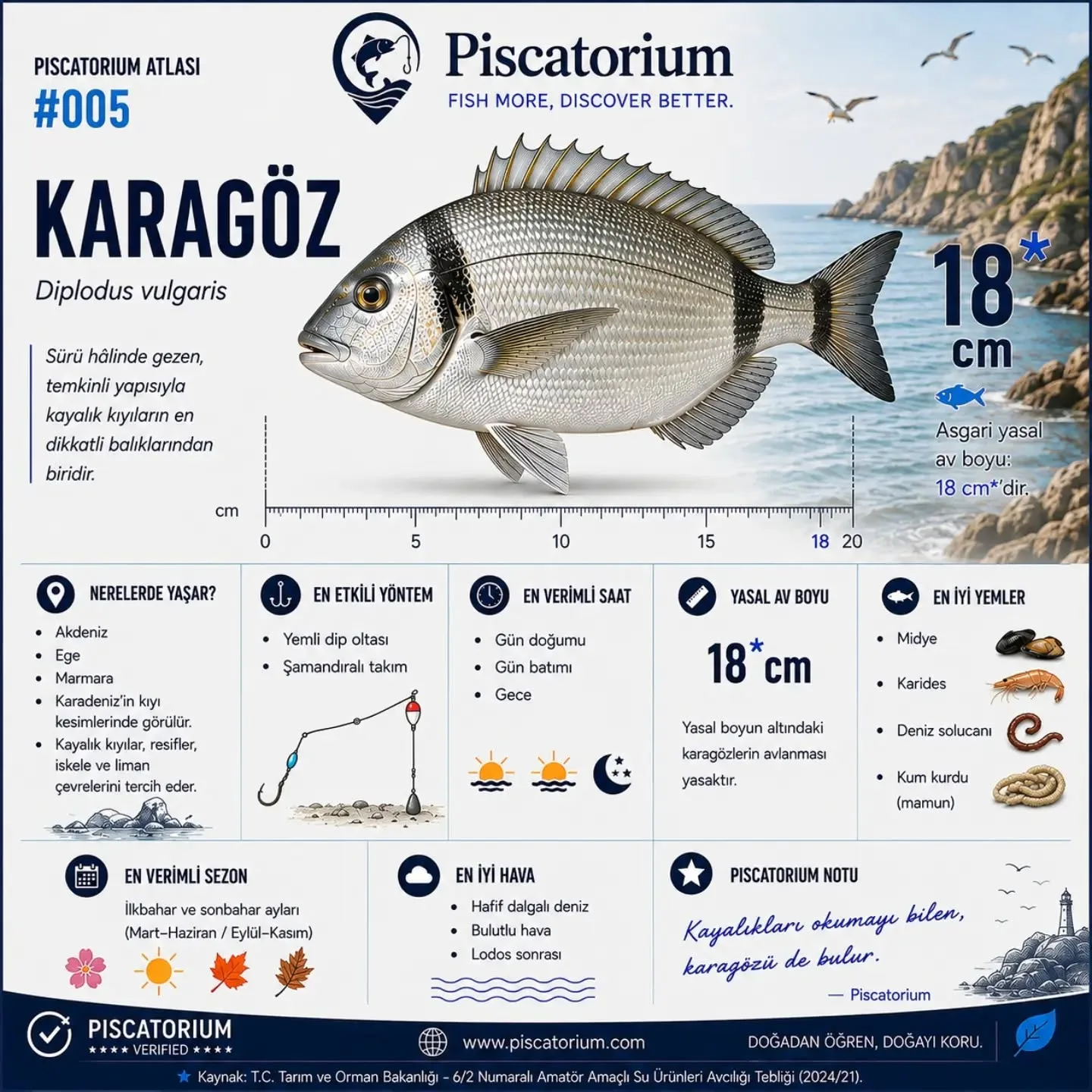
Karagöz (Diplodus vulgaris), the two-banded sparid of rocky shores; in our catalog it is recorded in the Marmara, the Aegean and the Mediterranean, with no Black Sea row. It is marked as productive year-round in all three seas, and the minimum legal size is 18 centimeters.
Two bands, one confusing name
The most distinctive mark of the karagöz is its two dark bands. One runs down just behind the head, from the nape toward the pectoral fin; the other wraps around the caudal peduncle like a ring. The body is silvery-grey, and thin lengthwise lines can be made out on the flanks. That is why one of the local names in our catalog is "two-banded karagöz".
The fish it is most often mistaken for on the shore is its relative the White seabream (Diplodus sargus). The White seabream has many thin, vertical dark stripes on its body and no broad band on the nape; the black spot on the caudal peduncle can appear in both species, so it is not a distinguishing mark on its own. The two species belong to the same family (Sparidae) and live on the same rocky shore, but they sit on separate rows in the communiqué: the limit is 18 for karagöz and 21 centimeters for the White seabream.
The name causes a second mix-up. In our catalog one of the local names of the Atlantic horse mackerel is also "Karagöz istavrit"; this is a completely different family, Trachurus trachurus. The karagöz row in the communiqué is matched by scientific name, so it applies to Diplodus vulgaris. The Atlantic horse mackerel has its own limit, which after the 16 September 2026 amendment is 12 centimeters.
Where is it recorded on the rocky shore?
The recorded habitat is rocky shore, its ecological group is "rocky/demersal", and its shore-fishing suitability is "high". Rocky points reachable on foot, the bases of breakwaters and rocky coves are this species' territory.
Along the Turkish coast the karagöz is linked to 307 spots: Marmara 192, Aegean 67, Mediterranean 48. Our catalog has 398 spots on the Marmara coast in total; the karagöz is recorded at 192 of them. The weight of the Marmara shows in the provincial ranking too: İstanbul leads by a wide margin with 116 spots. Çanakkale follows with 27, İzmir with 26, Antalya and Muğla with 24 each, and Kocaeli with 21 spots. These numbers show not abundance but in how many spots the species is recorded.
There is no sea row for the karagöz in the Black Sea. This does not mean the fish is never seen there; the catalog's verified data simply does not extend to that coast.
When: recorded year-round
In all three rows, Marmara, Aegean and Mediterranean, all twelve months are marked; the karagöz is a year-round recorded species. There is no season to wait for; what changes is the fish's behavior.
As general fishing knowledge, the karagöz stays closer to the shore and is more active in the warm months, and withdraws to somewhat deeper water in winter. Dusk and night hours are when this species is most sought on rocky shores. After a rough day, as the sea settles, the food that has piled up at the foot of the rocks also draws the fish to the shore. You can find the effect of wind direction on the shore in the article which wind is good for fishing.
Bait: mussel, shrimp, ragworm
The species record lists mussel, shrimp and ragworm as natural bait, and silicone worm and micro jig as lures. Under fishing technique there are three headings: bottom, float and LRF. In all three sea rows the technique is LRF, and the prominent lure is the silicone shad.
The supporting bait rows differ from coast to coast: in the Marmara, European anchovy, Atlantic horse mackerel and shrimp; in the Aegean, European sardine, ragworm and a type of lugworm (sülünez); in the Mediterranean, European sardine, European squid and shrimp.
Rig it for the rocks
The karagöz is a wary fish; it tests the bait first and takes it afterwards. The known setup that suits this behavior is a thin leader, a small hook and a small piece of bait that hides the hook. With a float rig, the bait should hang at the edge of the rocks, close to the bottom; with a bottom rig, the sinker should land in a gap of sand or gravel where it won't wedge between the stones. On the LRF side, silicones mounted on a light jig head are worked with short twitches at the foot of the rock. When the fish feels the hook it tries to bolt for the rocks; not leaving the reel's drag too loose saves your rig.
Where to look on the rocks?
On a rocky shore, not every stone is the same. The line where the wave breaks and leaves foam, the pockets where water opens from between the rocks onto sand, and mussel-covered breakwater stones are among the places where the karagöz feeds. In clear water the fish can see you by day and won't approach; as the light fades it moves in toward the shore. The two sides of the same rock, the one exposed to wind and the one sheltered, also behave differently: one turns murky and carries food, while the other stays clear.
Schools of young karagöz are often seen on the shore, and most of them stay under 18 centimeters. If small fish keep coming one after another, enlarging the hook and the bait reduces the number of small individuals getting hooked; if the school is small, moving to another spot is better than insisting on the same one. Handle a fish below the limit with a wet hand and put it back in the water without wasting time.
Rule: 18 centimeters
| Species | Minimum size | Daily limit | Closed season |
|---|---|---|---|
| Karagöz (Diplodus vulgaris) | 18 cm | 5 kg | — |
| White seabream (Diplodus sargus) | 21 cm | 5 kg | — |
| Atlantic horse mackerel (Trachurus trachurus) | 12 cm | 5 kg | — |
Basis: recreational fishing communiqué no. 6/2, 2024/21 Table 7. No species-specific seasonal ban is stated for the karagöz; the area and method provisions still apply. The absence of a closed season does not mean the rule is light: the karagöz most easily reached from the shore are mostly young individuals, so the size limit is tested on this species every evening. The quantity is per person and per day. Use the table as a reminder: the binding text is the official communiqué, so check the current publication before you fish. The limits for all species are on the legal fish sizes page.
For a fish you can't tell apart as karagöz or White seabream, the safest course is to go by the larger limit, that is, 21 centimeters. The species' profile, the sea-by-sea monthly table and the bait records are on the karagöz species page.