


















4 min read
When is Atlantic bonito caught, and what is the legal size?
A migrant recorded in all four Turkish seas, linked to 136 fishing spots in the Black Sea. Productive months and where the closed season cuts into the calendar.
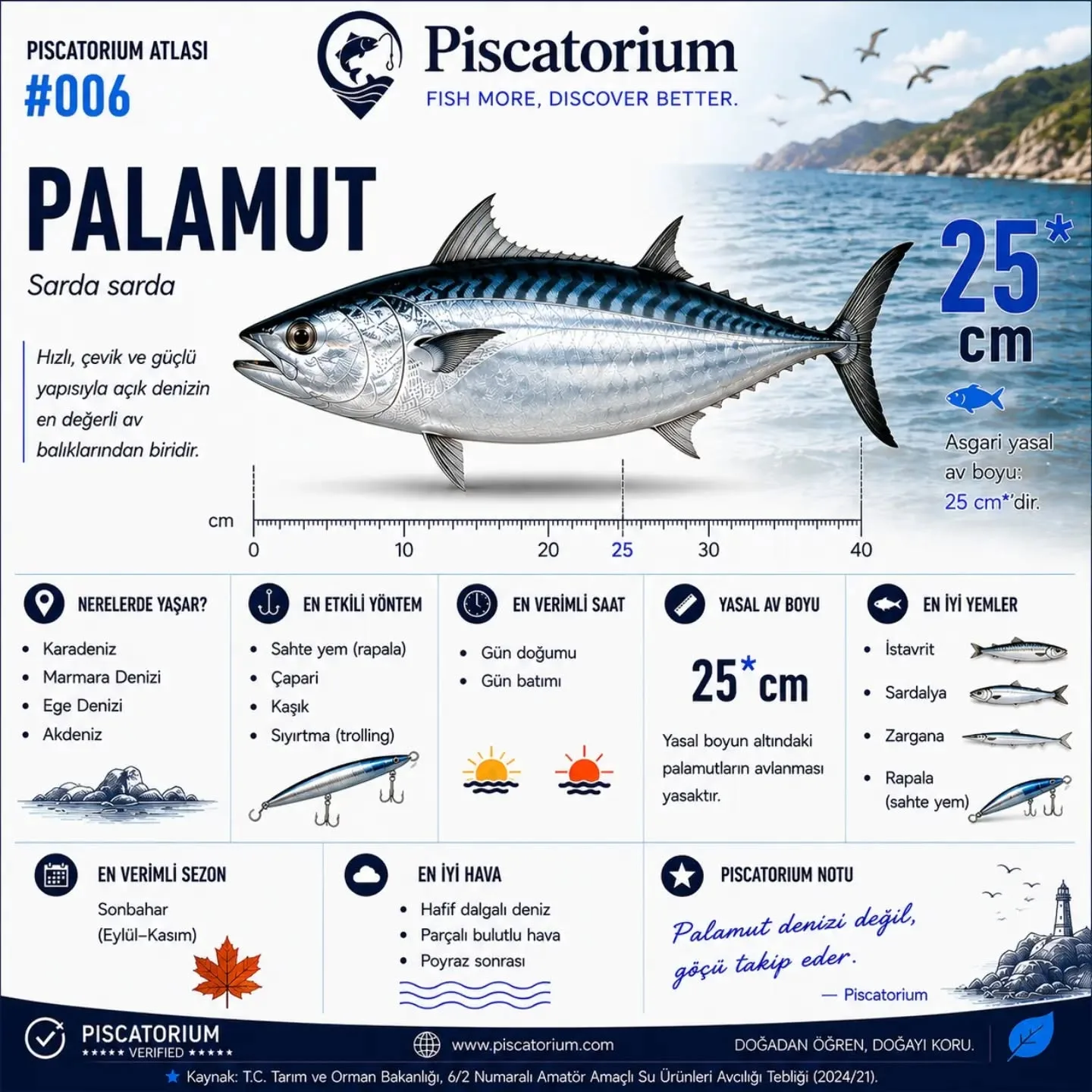
Atlantic bonito (Sarda sarda) is a migratory schooling fish of the mackerel family; in our catalogue it is recorded in all four seas: the Black Sea, the Marmara, the Aegean and the Mediterranean. Its minimum legal size is 25 centimetres and fishing for it is closed between 1 April and 14 August. That is why its season is shaped by the communiqué's calendar as much as by the fish's migration.
Palamut, torik, kestane palamudu
In our catalogue the local names of the Atlantic bonito are "Palamut", "Kestane palamudu" and "torik". They are all the same species; in anglers' talk the name often changes with size, and a large palamut is called torik. The communiqué, however, looks at centimetres, not at names: whatever it is called, the limit is 25 centimetres.
The species notes in our catalogue also record that this confusion is an old one. According to Zengin and Ulman, in the early 1950s Black Sea fishermen thought the small palamut and the large torik were two separate species; a study later confirmed they are the same species. The Istanbul Metropolitan Municipality's note on the palamut likewise says the small one is called palamut and the large one torik.
The easiest way to recognise an Atlantic bonito is to look at the back. The back is bluish, the lower part of the flanks and the belly are silvery; the dark, slanting lines running down from the back are the signature of this species. The body is spindle-shaped and muscular, the mouth is large, and there are pointed teeth in the jaws. According to the FAO mackerel catalogue cited in the species notes, the first dorsal fin has 20–23 spines, the two dorsal fins sit close together, and there is a well-developed central keel on each side of the slender caudal peduncle. Our catalogue classifies the species in the "pelagic predator" group and as migratory.
Confusion with the Atlantic mackerel and the Atlantic chub mackerel
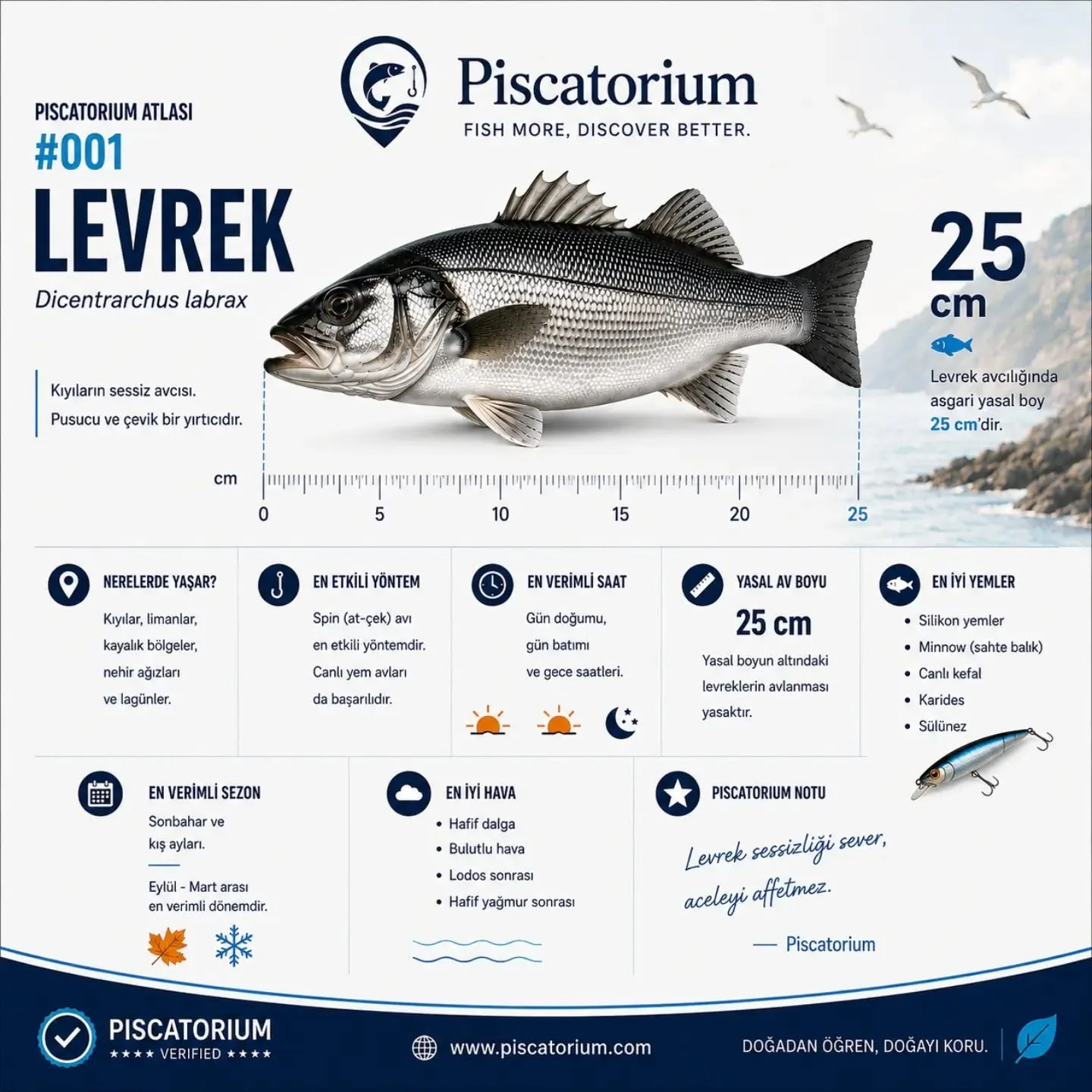
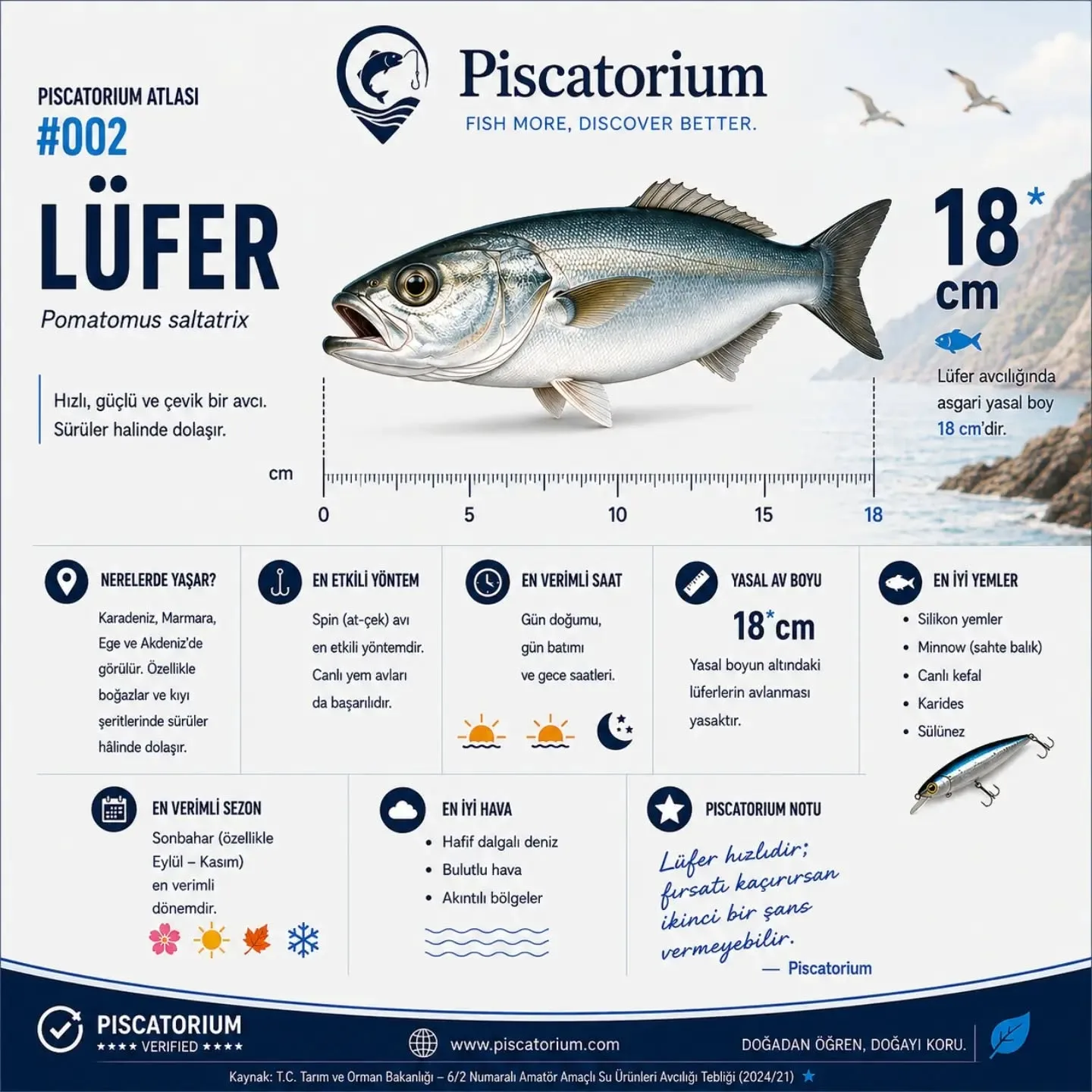
Two members of the same family are often mistaken for the Atlantic bonito along the shore. The lines on the back of the Atlantic mackerel are wavy rather than slanting, and its body is slimmer. The back of the Atlantic chub mackerel also has a wavy pattern, while dark spots can be seen on its belly side. The limits of the three differ: 25 centimetres for the Atlantic bonito, 20 for the Atlantic mackerel, 18 for the Atlantic chub mackerel. Mistaking a young Atlantic bonito for an Atlantic mackerel and measuring it against the 20-centimetre limit means putting a bonito under 25 centimetres into your bucket without realising it.
Productive months and the part cut by the closed season
| Sea | Productive months | Part falling in the closed season |
|---|---|---|
| Black Sea | All year | 1 April – 14 August |
| Marmara | August – December | First half of August |
| Aegean | August – December | First half of August |
| Mediterranean | July – November | July and the first half of August |
The Marmara and the Aegean share the same window; the Mediterranean opens a month earlier and closes a month earlier. In the Black Sea row, all twelve months are marked. This shows that records continue all year, but it does not show that fishing is free all year: between 1 April and 14 August the Atlantic bonito is closed in every sea. Even though July is marked as productive in the Mediterranean, the whole month falls within the ban.
The general outline of the migration is well known along the coast. Atlantic bonito schools move down in autumn from the Black Sea to the Istanbul Strait, and from there to the Marmara and the Aegean; in spring they go back up to the Black Sea in the opposite direction. This is general knowledge handed down along the coast from generation to generation; it does not rest on the month rows in the catalogue, and the passage of the schools can shift from year to year. So it is no surprise that a fish that shows up everywhere one week pulls away from the shore the next.
Recorded spots are on the Black Sea coast
Although the month data covers four seas, the spot records are concentrated in a single sea: in our catalogue the Atlantic bonito is linked to 136 spots on the Turkish coast, and all of them are in the Black Sea row. No coastal spot has yet been linked for the Atlantic bonito in the Marmara, the Aegean or the Mediterranean; this does not mean there are no Atlantic bonito there.
In the ranking by province, İstanbul leads with 24 spots; it is followed by Kocaeli with 14, Düzce and Bartın with 13 each, and Zonguldak with 11 and Sinop with 10 spots. Since all the spots are in the Black Sea row, the records in İstanbul and Kocaeli, which have coasts on two seas, are also counted on the Black Sea side of the catalogue. This number tells how many spots have a record of the species, not how abundant it is: having a record at a spot does not guarantee that a school will pass there that week. How the current steers migrating schools is explained in the Strait fishing article.
Bait and technique: spoon, trolling, European anchovy
The species record lists European anchovy, Atlantic horse mackerel and garfish as natural bait, and spoon, minnow and jig as artificial lures; the fishing technique field lists trolling, spinning and jig. The Marmara, Aegean and Mediterranean rows repeat this trio exactly and give "European anchovy / spoon" as the leading bait. The Black Sea row differs: the technique is only spinning, and the leading bait is a sinking minnow.
Regional supporting baits change from coast to coast: in the Marmara, European anchovy, Atlantic horse mackerel and shrimp; in the Black Sea, European anchovy and European sprat; in the Aegean, European sardine, mamun and sülünez; in the Mediterranean, European sardine, European squid and shrimp. The European anchovy comes first in the supporting rows of the Marmara and the Black Sea; in the Aegean and the Mediterranean the European sardine takes that place.
The rhythm of Atlantic bonito fishing is set by the school, and the routine known along the coast works like this. When the school dives on small fish at the surface, the water is seen boiling and gulls gather; a spoon or a sinking minnow cast to that spot is worked with a fast retrieve. Trolling is a method of dragging bait or a lure behind a boat at a slow pace; of the recorded natural baits, rigging a garfish whole and trailing it this way is a practice known along the coast. Since the Atlantic bonito's teeth are hard, the leader and knots should be checked often.
Size, quantity and season
| Species | Minimum legal size | Daily limit | Closed season |
|---|---|---|---|
| Atlantic bonito (including torik) | 25 cm | 5 kg | 1 April – 14 August |
| Atlantic mackerel | 20 cm | 5 kg | — |
| Atlantic chub mackerel | 18 cm | 5 kg | — |
Basis: recreational fishing communiqué no. 6/2, 2024/21 Table 7. An Atlantic bonito caught during the closed season is released regardless of its size; even when the season is open, a fish under 25 centimetres cannot be kept. The quantities are per person and daily. The table is for information only; the official communiqué is the binding text, so check its current edition before you go fishing. The limits for all species are on the legal fish sizes page.
The sea-by-sea month table and the bait records are together on the Atlantic bonito species page. Which other species are recorded in the Marmara in the same months is shown by the month-by-month species calendar.