































4 min read
Where does white seabream live, and with what bait and size is it caught?
A year-round fish of the rocky shore: productive twelve months in Marmara, the Aegean and the Mediterranean, recorded at 307 fishing spots, minimum size 21 cm.
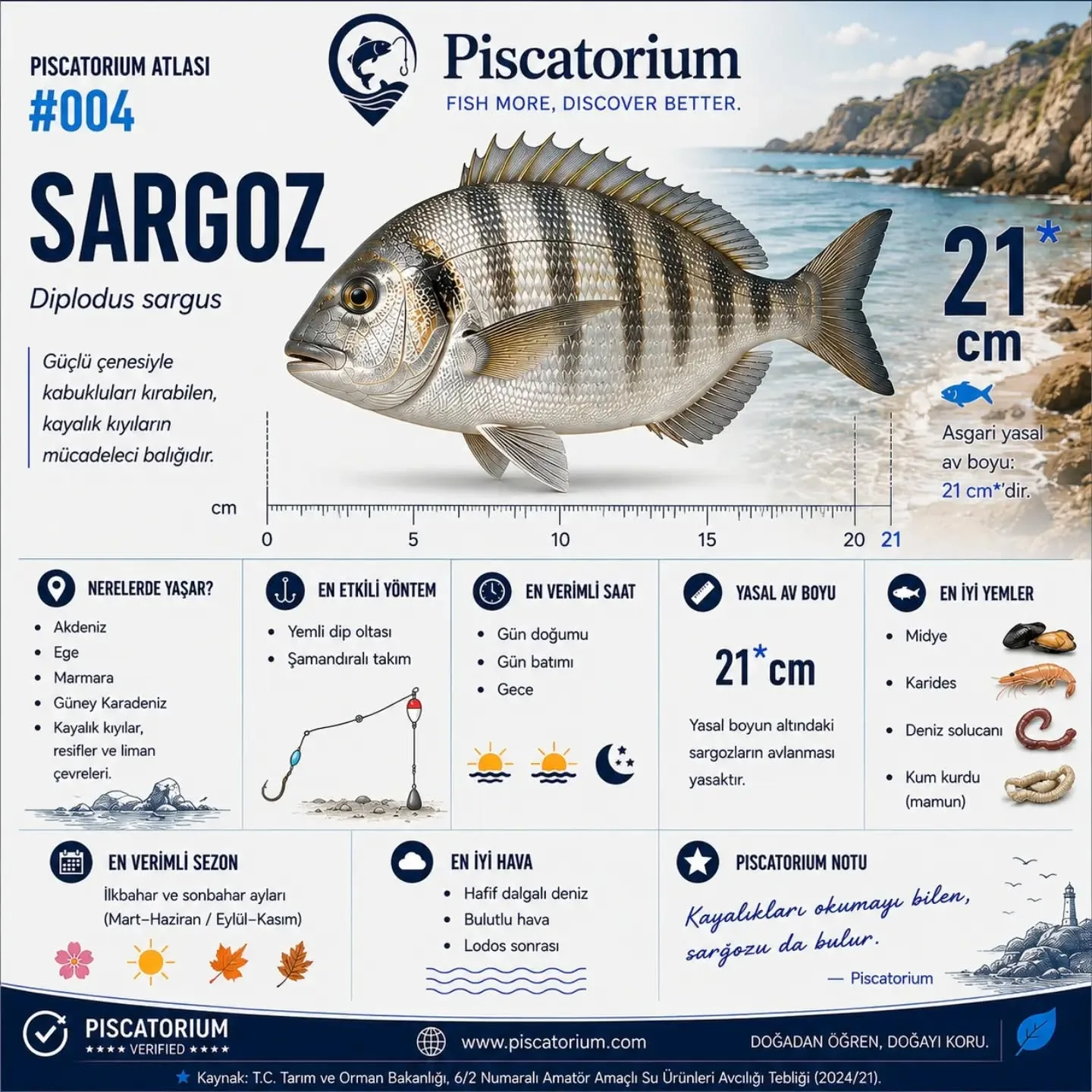
White seabream (Diplodus sargus), called "sargos" in the communiqué, is a strong-jawed sparid of rocky shores. In our catalogue it is recorded in the Marmara, the Aegean and the Mediterranean, and its minimum legal size is 21 centimetres, three centimetres more than the limit for its close relative, the common two-banded seabream.
What size can you keep?
| Species | Minimum size | Daily limit | Closed season |
|---|---|---|---|
| White seabream (Diplodus sargus) | 21 cm | 5 kg | — |
| Common two-banded seabream (Diplodus vulgaris) | 18 cm | 5 kg | — |
Basis: Recreational Fishing Communiqué No. 6/2, 2024/21 Table 7. No species-specific closed season is stated for the white seabream, so there is no closed month on the calendar; area and method provisions still apply separately. The daily limit is 5 kilograms per person. These numbers are a summary; the official communiqué is the binding text, so check the current edition before you fish. The limits for all species are on the legal fish sizes page.
18 centimetres is the limit for the common two-banded seabream. Anyone who mixes up the two species can easily overlook the three-centimetre difference on a white seabream. It is also hard to tell sizes near the limit by eye on the rocks; carry a measuring tape, use the larger limit for a fish whose species you can't identify, and release it if in doubt.
Recognising the white seabream
The white seabream has a deep, laterally compressed body and a silvery colour. Along its sides there are many thin, vertical dark lines; these are conspicuous in young fish but can fade in large individuals. There is a distinct black spot on the caudal peduncle. The mouth is strong, with cutting front teeth and grinding back teeth: the fish uses them to crack mussel and crab shells. In our catalogue its local names are "Sargoz" and "Sargos".
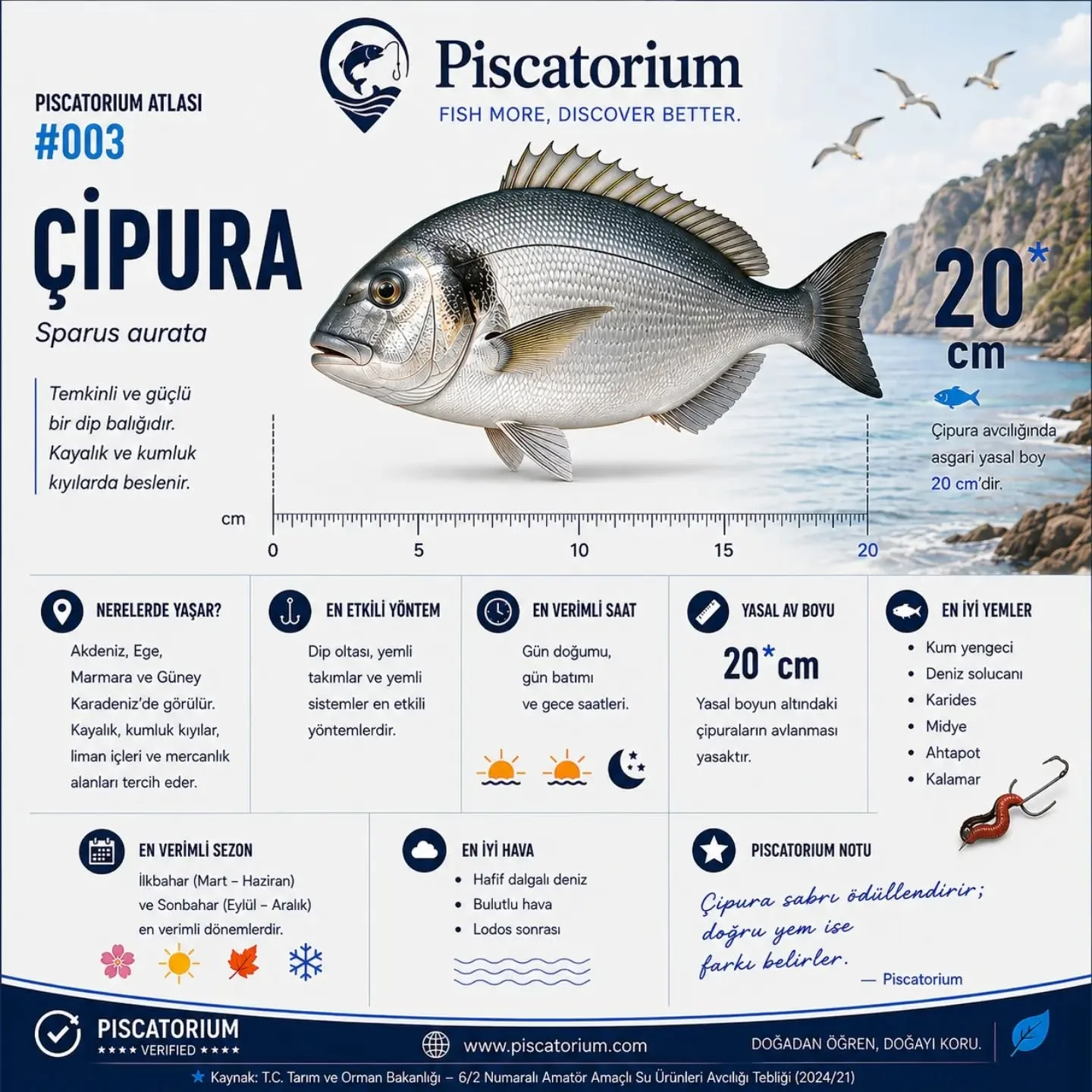
The species it is most often confused with is the common two-banded seabream (Diplodus vulgaris). The two-banded seabream has a broad dark band on the nape and a second band around the caudal peduncle; the white seabream has no such band on the nape, and instead thin lines run along the body. Both species belong to the same family (Sparidae) and live on the same rocky shore, but since their limits differ, you have to tell them apart on the spot. Another familiar member of the family on the shore is the gilthead seabream; it is recognised by the golden band between its eyes, and its limit is 20 centimetres. Keep in mind that on the same rocks you can meet three species with three different limits.
Where does it live?
Its recorded habitat is rocky shore, its ecological group is "rocky/demersal" and its shore-fishing suitability is "high". Along the Turkish coast it is linked to 307 spots: Marmara 192, the Aegean 67, the Mediterranean 48. The proportions vary from sea to sea: of the 398 Marmara spots in our catalogue, 192 have a white seabream record, while this drops to 67 of 377 spots in the Aegean and 48 of 295 spots in the Mediterranean. There is no sea row for the Black Sea; our catalogue holds no verified white seabream record on that coast, but that does not mean the fish is never seen there.
In the ranking by province, İstanbul leads with 116 spots. It is followed by Çanakkale with 27, İzmir with 26, Antalya and Muğla with 24 each, and Kocaeli with 21 spots. The number of spots measures how widespread the fish is: a record at a spot does not mean the fish is abundant on that shore.
Sea conditions matter more than season
In all three of the Marmara, Aegean and Mediterranean rows, all twelve months are marked: the white seabream is recorded year-round. For this species, the conditions of the day matter more than the calendar.
The kind of shoreline the white seabream likes is well known: places where the swell hits the rocks and leaves white water, and the water turns slightly murky. Rough sea stirs crustaceans and small creatures loose from the rocks into the water, and the white seabream comes in to take the opportunity. On a completely calm, clear day it is wary; at dusk and at night it comes closer to the shore. It is known to retreat to deeper rocky areas when the water cools in winter; being recorded year-round does not mean you can find it from the shore with equal ease every month.
As the swell grows, standing on the rocks becomes dangerous; you, not the fish, must set the safety limit. You can find how each wind affects each shore in the article which wind is good for fishing.
What do you catch it with?
The species record lists mussel, crab and shrimp as natural bait and silicone and small jigs as artificial lures; the fishing technique field has bottom fishing and LRF. In all three sea rows the technique is LRF, with the silicone shad as the standout lure. Regional supporting baits vary by coast: in the Marmara European anchovy, Atlantic horse mackerel and shrimp; in the Aegean European sardine, mamun and sülünez; in the Mediterranean European sardine, European squid and shrimp.
The bait list fits the fish's teeth: for a shell-crushing fish, mussel and crab are the natural choice. As general knowledge, once hooked the white seabream bolts for the rocks with a strong rush. That is why a thin but strong line, a small hook with thick wire and a firm enough drag matter. With bottom rigs, dropping the sinker into a patch of sand or gravel in front of the rocks reduces snagging. For LRF, the silicone is worked with short twitches along the foot of the rock.
Keeping the bait on the hook
Mussel meat is soft; with a hard cast it can tear off the hook and fall away. The solution coastal anglers know is to put the meat on the hook and then wrap it with a few turns of thin, stretchy thread. Crab can be hooked whole or split in two; thanks to its shell it lasts long on the hook and resists nibbling by small fish. Shrimp stays on more firmly when hooked with its shell. Whichever bait you choose, it matters that the hook point stays exposed so that it can penetrate the white seabream's tough mouth.
The behaviour of the white seabream also changes with size. The young stay close to shore, roaming in crowded groups, and most are under the limit; large individuals are warier, more solitary and stay close to the deep face of the rocks. So casting to the deep edge of the rocks rather than at the shoal nearest the shore does two things: it reaches larger fish and leaves the undersized white seabream alone.
The species' month-by-month table for each sea and its bait records are together on the white seabream species page. The page shows the rule according to the region you are in; along the Turkish coast the limit you read is the 21 centimetres above.