





















4 min read
Swordfish: 110 cm and two closed seasons
Minimum size is 110 cm fork length, the daily limit is one fish, and there are two separate closed seasons a year. For swordfish, the communiqué sets the calendar.
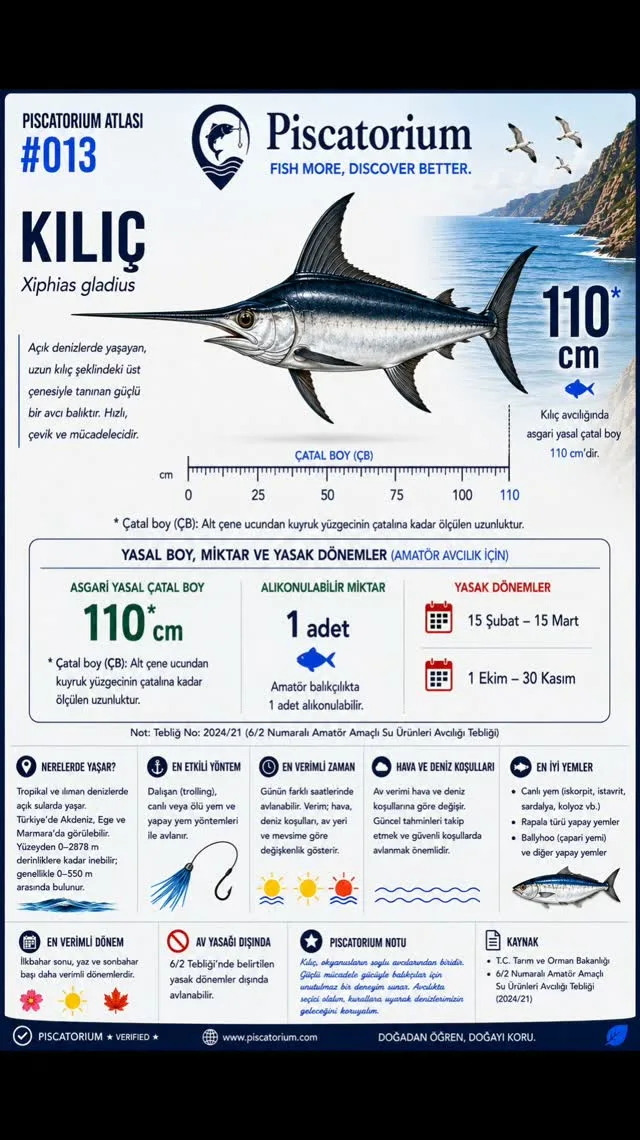
For swordfish (Xiphias gladius), the minimum legal size for recreational fishing is 110 cm measured as fork length, and the daily limit is 1 fish. The fishery is closed twice a year: 15 February – 15 March and 1 October – 30 November. In our catalogue it is an offshore fish recorded in Türkiye for the Aegean and the Mediterranean.
Swordfish or marlin?
Swordfish are not hard to recognise. The upper jaw extends into a long, flat blade with sharp edges, and the species gets its name from this. Adult fish have no scales and no pelvic fins. The first dorsal fin is tall and sickle-shaped, and there is a distinct keel on each side of the tail stalk. The back is dark brown-purple and the belly is paler.
Marlins, the spearfish relatives that can turn up in the Mediterranean, are the main group it can be confused with. Their bill is shorter and round in cross-section, they have pelvic fins, and the dorsal fin runs along the length of the body. This distinction matters, because the 110 centimetres and the closed periods in this article are written only for Xiphias gladius.
Calendar: the productive months are split by two closures
Both the Aegean and Mediterranean entries record seven productive months each. The February – March closure does not fall on any of those months, but the October – November closure cuts off the tail end of the season:
| Sea | Months marked productive | Falling in the closure | Remaining open |
|---|---|---|---|
| Aegean | May – November | October, November | May – September |
| Mediterranean | April – October | October | April – September |
So in practice the swordfish season ends at the end of September in both seas. That leaves five months in the Aegean and six in the Mediterranean, where the window opens a month earlier in spring. Even though the records call October and November productive, any swordfish caught in those months goes back into the sea, whatever its size.
Where: open sea
The swordfish's recorded habitat is the open sea, and its catchability from shore is rated "low". It is not a species to target from the shore or a pier; you look for it from a boat, in deep water far from the coast. Our catalogue has records for the Aegean and the Mediterranean; there is no swordfish record for the Sea of Marmara or the Black Sea.
The species is not tied to individual fishing spots; the record is at sea level. For an offshore fish that is no surprise: the swordfish's place is not a pier or a cove but the line of currents and baitfish schools. General angling knowledge describes the swordfish as a fish that dives deep by day and comes close to the surface at night, so the fishing depth changes with the time of day. Sudden drop-offs are lines generally sought in offshore fishing; the depth contours on the map make it easier to see these edges without leaving the shore.
Bait: squid and mackerel
For both seas the main bait is recorded as "squid / deep-diving lure". The natural bait list is short: European squid and Atlantic mackerel. Regional supporting baits differ: in the Aegean, sardine, mamun and sülünez; in the Mediterranean, sardine, squid and shrimp. On the lure side there is a single entry: the deep-diving lure, meaning a large lure designed to sink to the depth you want.
If you use mackerel as bait fish, there is a rule you must not forget: the mackerel's own minimum size is 20 centimetres. A mackerel under this size cannot be kept even as bait.
Technique: trolling and drifting
Two techniques are recorded. Trolling means towing bait or a lure behind the boat while it moves slowly. Drifting means stopping the engine and letting the boat drift with the wind and current; meanwhile the baits are held suspended at different depths. Working the bait close to the surface at night and much deeper by day is the general framework of this technique.
The swordfish is a big, powerful fish, and the fight can be long. That is why heavy tackle, a reliable drag system and a thick abrasion-resistant leader are used. The bill of a fish coming up to the boat is dangerous too: trying to bring the fish onto the deck without control can injure both the fish and the people on board.
Offshore fishing is above all a matter of weather. On a small boat far from shore, wind and waves changing within a few hours affect the trip home more than the fishing. Before heading out you need to check wind direction and speed, wave height and how the day is developing; the article which wind is good for fishing explains how to read this.
Size, quantity and two closed periods
| Species | Minimum size | Daily limit | Closed period |
|---|---|---|---|
| Swordfish | 110 cm (fork length) | 1 fish | 15 February – 15 March; 1 October – 30 November |
| Atlantic bluefin tuna | 115 cm (fork length) | 1 fish | 15 October – 15 June; fishing requires a permit |
The two species in the table are large offshore fish measured by fork length in the communiqué. For bluefin tuna the closed period is much longer and fishing additionally requires a permit; for swordfish the fishery is closed in two separate parts of the year. The Mediterranean swordfish stock is one of those monitored at the international level; keep in mind that the rules may change over time.
For swordfish, the measurement is taken not to the tip of the tail but to the middle of the tail fork. Where the measurement starts also matters because of the long upper jaw: in international practice, swordfish is generally measured from the tip of the lower jaw. Check the definition in the communiqué before you fish; whether the bill counts toward the measurement completely changes the result for a fish near the limit. We explain the measurement types in the article what is the legal size.
If a swordfish is under the limit or comes in during a closed period, leave it in the water without bringing it aboard if you can; cutting the line close to the hook does less harm than struggling to remove the hook. The figures come from communiqué no. 6/2 on recreational fishing; the official communiqué is the binding text, so check the current publication before heading out. The limits for all species are on the legal fish sizes page, and the sea-by-sea records for swordfish are on the swordfish species page.