

























6 min read
What is a minimum size, and why does it matter?
The legal size is the smallest length a species must reach before it can be caught; in the communiqué it is called the minimum fishing size. The purpose is simple: to make sure the fish has spawned at least once. A fish caught below the limit is returned to the sea; in everyday speech this is also called the fish size ban.
The rule binds not only commercial fishermen but also amateurs casting a line from the shore. The limits are renewed in four-year communiqué periods; the current period began on 1 September 2024 and ends on 31 August 2028. Below you will find the limits for the most commonly caught species, how measurement is done, and the other rules that apply alongside size.
What is the legal size in centimetres for each fish?
| Species | Minimum size | Daily limit | Closed season |
|---|---|---|---|
| Red mullet, striped red mullet | 12 cm | 5 kg | — |
| Atlantic horse mackerel (Atlantic horse mackerel) | 12 cm | 5 kg | — |
| Mediterranean horse mackerel, whiting | 13 cm | 5 kg | — |
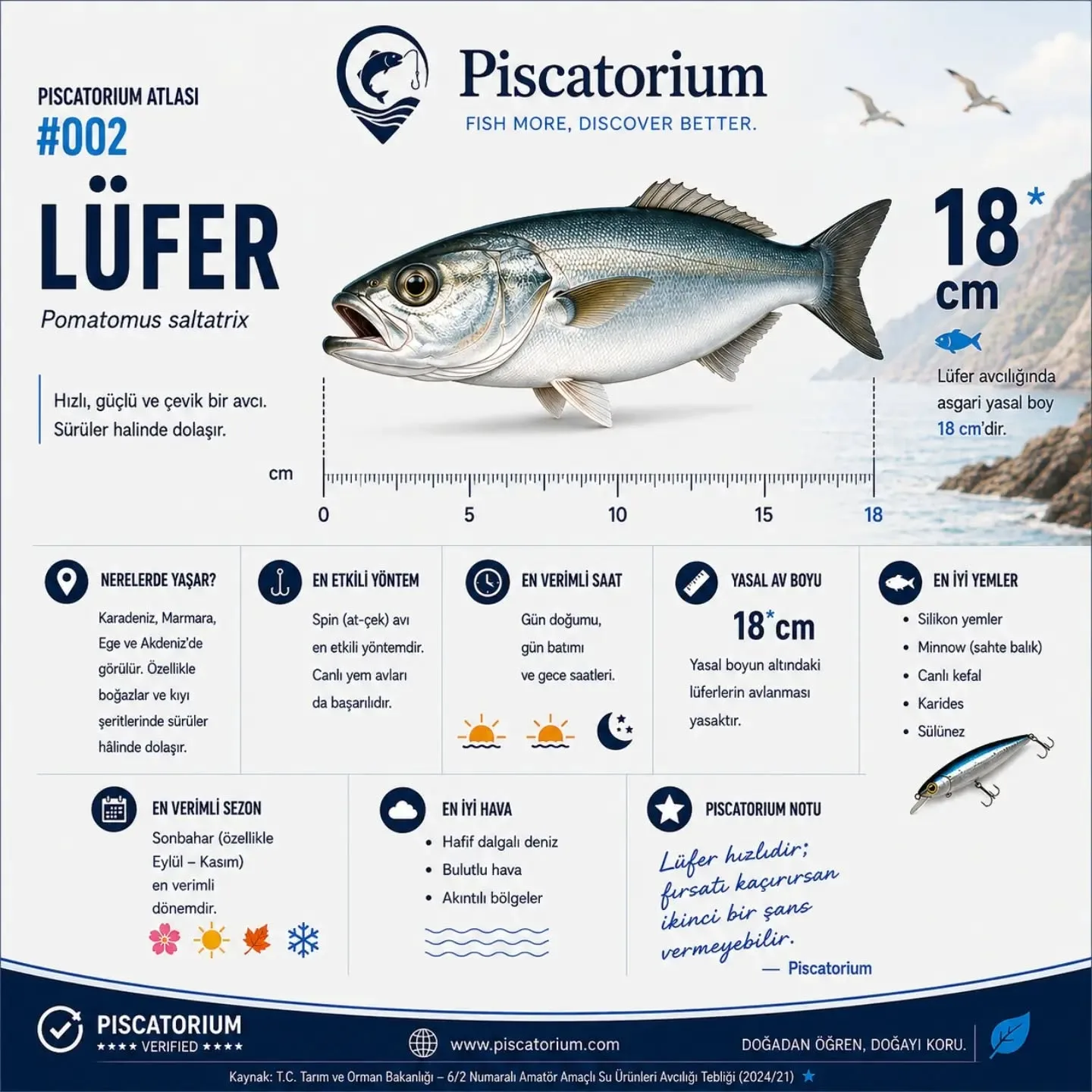
| Bluefish, Atlantic chub mackerel, common two-banded seabream | 18 cm | 5 kg | — |
| Gilthead seabream, Atlantic mackerel | 20 cm | 5 kg | — |
| White seabream | 21 cm | 5 kg | — |
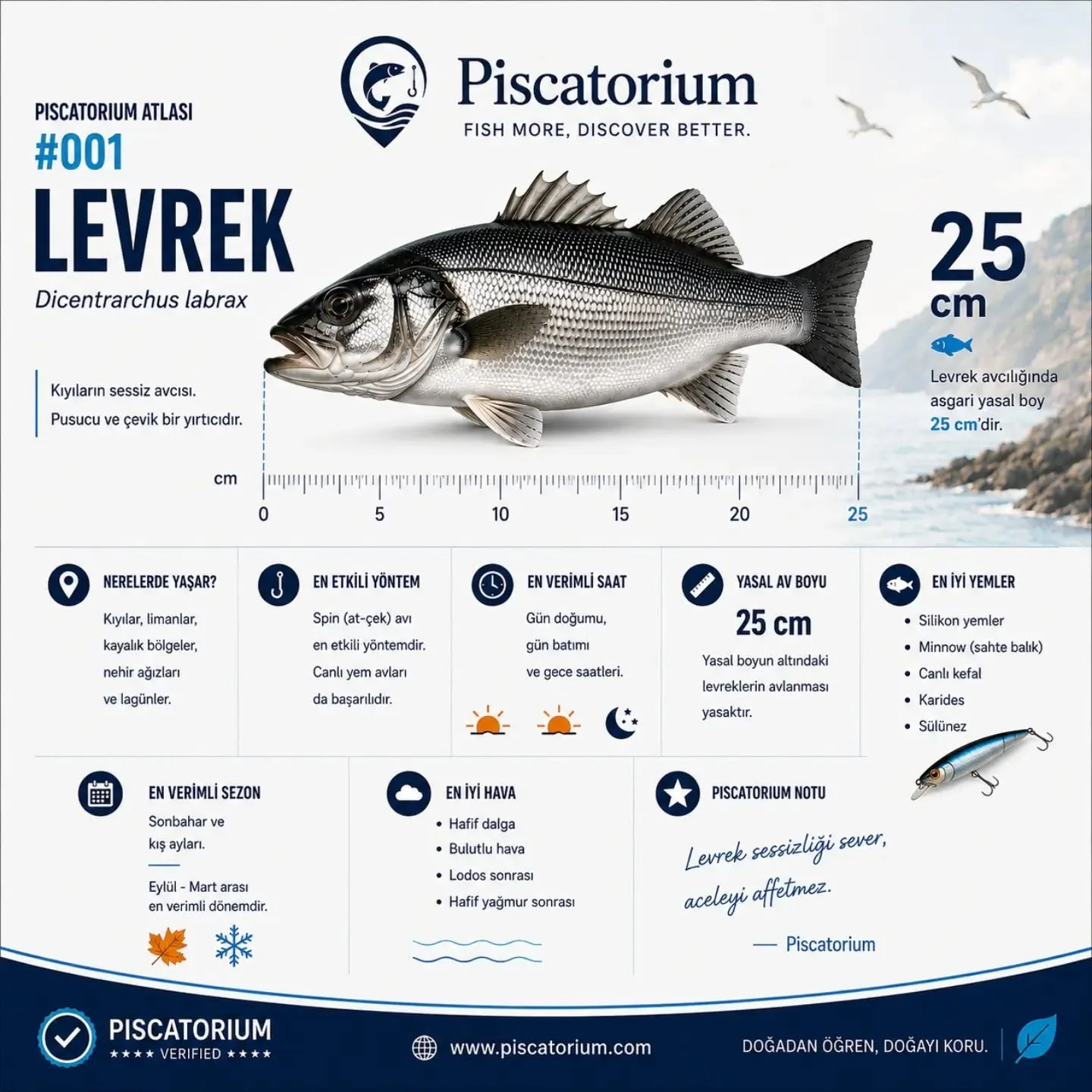
| European seabass | 25 cm | 5 kg | — |
| Atlantic bonito | 25 cm | 5 kg | 1 April – 14 August |
| Flathead grey mullet | 30 cm | 5 kg | — |
| Common dentex | 35 cm | 5 kg | — |
| Leerfish | 40 cm | 1 piece | 15 April – 15 May |
| Turbot | 45 cm | 1 piece | 15 April – 15 June |
| White grouper | 50 cm | 1 piece | 1 June – 31 August |
| Swordfish | 110 cm | 1 piece | 15 February – 15 March, 1 October – 30 November |
Source: Communiqué No. 6/2, Article 15 – Table 7. The table includes the communiqué’s latest amendment, published on 16 September 2026 (No: 2026/26): the minimum size of the Atlantic horse mackerel was lowered from 13 to 12 centimetres, and the closed season for the common sole became 1 February – 14 March. The table has numeric limits for 38 species and species groups; the full list and the closed seasons are in the article which fish are banned from fishing.
How is the legal size measured?
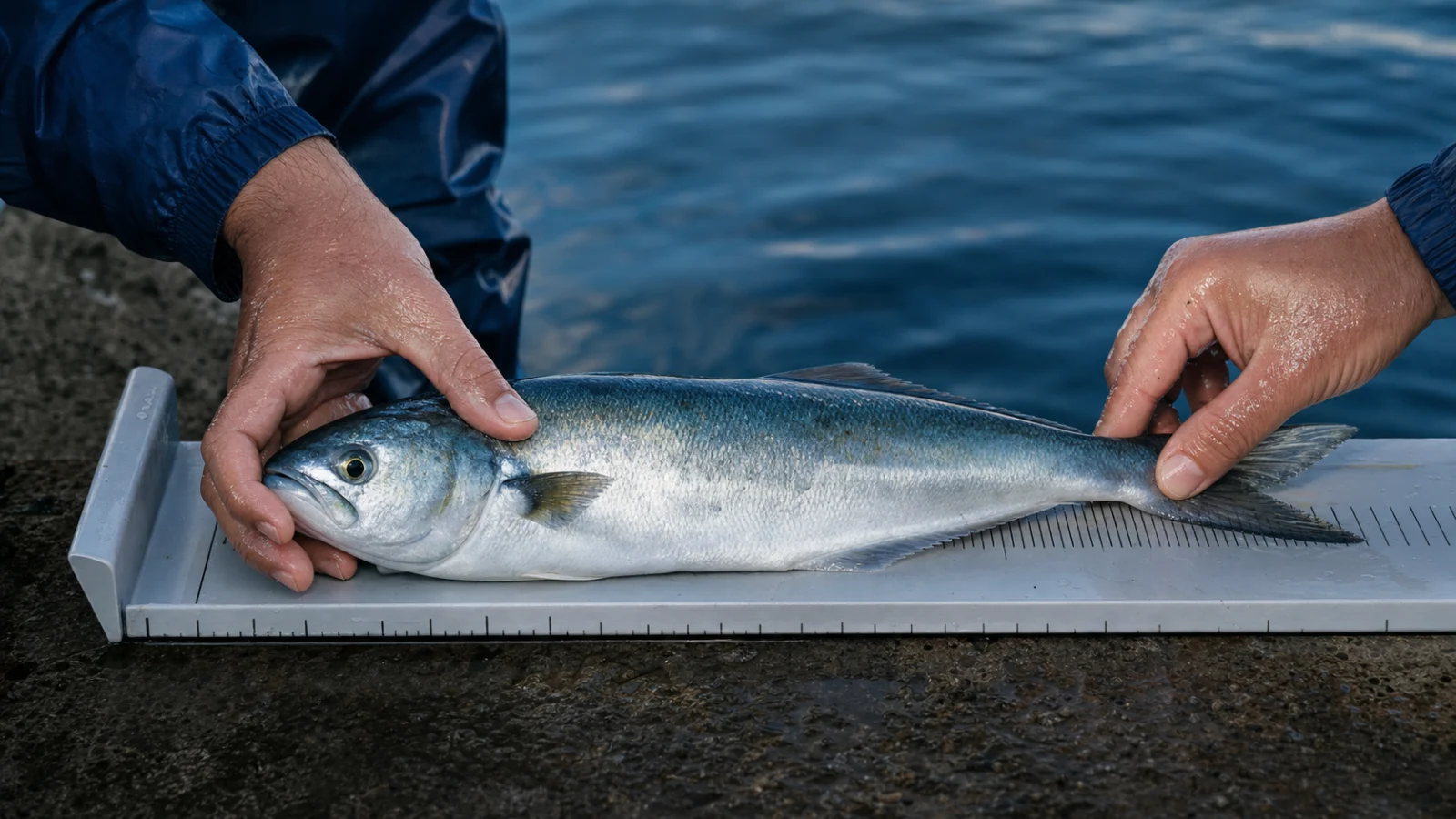
Measurement is taken from the tip of the nose to the tip of the tail (total length). For some species, such as Atlantic bluefin tuna and swordfish, fork length is used: from the tip of the nose to the middle of the tail fork. For the common octopus the measure is weight rather than length; an octopus under 750 grams is released. The communiqué states which measurement applies to which species.
In practice, the most reliable way is to carry a tape measure or a bucket with centimetre marks on it. You can’t tell 23 from 25 centimetres by eye; if you have any doubt about a fish near the limit, it goes back in the water. When measuring, lay the fish on a flat surface, keep its mouth closed and leave the tail in its natural position; with a curled or stretched fish, a deviation of a few centimetres can make a fish just above the limit look compliant on paper.
Why does a minimum size exist?
The numbers aren’t arbitrary; they are set according to the size at which a species completes its first spawning. If a fish is caught only after it has laid eggs at least once, the stock renews itself. Taking a fish below the limit means that fish leaves without ever having spawned. That is why the limit is 12 centimetres for the fast-growing Atlantic horse mackerel, but 45 centimetres for the late-maturing turbot.
The effect of amateur fishing on the total catch may look small, but the fish closest to the shore and easiest to reach are mostly young individuals. If dozens of people drop small fish into their buckets on a pier every evening, that decides what that shore yields a few years later. So the size limit is not someone else’s rule; it is the rule of the angler who will come back to the same shore next year.
Don’t mix up size names: the bluefish example
Some fish are known by different names depending on their size. Bluefish is the best-known example: defne yaprağı, snapper bluefish, sarıkanat, bluefish and kofana are names of the same species from small to large. The communiqué looks not at these names but at centimetres; since the limit is 18 centimetres, the small ones of defne yaprağı and snapper bluefish must go back in the water. The same goes for Atlantic bonito and its large size, torik: the name changes, but the species and the rule are one.
The most common mistake: confusing species
Similar-looking species can have different limits. The minimum size is 18 for common two-banded seabream and 21 centimetres for white seabream. With mullets it gets even more complicated: the limit is 30 for flathead grey mullet and 20 centimetres for the other mullet species. Red mullet and striped red mullet, however, are subject to the same limit, 12 centimetres. If you are unsure about a fish, going by the larger limit is the safest way.
There are also species not named in the table at all: picarel, garfish and annular seabream, for example. These have no numeric size limit, but the daily quantity limit still applies.
The quantity limit is a separate rule
Passing the size limit doesn’t mean you can take as many as you like. For most species the amount one person may keep per day is limited to 5 kilograms. For some species pieces are counted instead of weight: for turbot, leerfish, white grouper, swordfish and common octopus it is 1 piece per day, and for brown meagre 3 pieces. The 5-kilogram limit also applies to species not named in the table.
The quantity limit is calculated per person and per day; fishing in two different places on the same day doesn’t double the limit. The closed season is a third rule: Atlantic bonito between 1 April – 14 August and turbot between 15 April – 15 June cannot be kept whatever their size. Before putting a fish in the bucket, you need to answer “yes” to three questions: is it big enough, am I within the daily limit, is the season open?
How do you release an undersized fish?
A few seconds are enough to keep a small fish alive. Hold the fish with a wet hand, remove the hook without forcing it and don’t keep it out of the water for long. If the hook is deep, cutting the line short and letting the fish go does less harm than struggling to remove the hook. The same rule applies to a fish caught in the closed season.
Changing your method is also a solution where small fish keep coming. Using a bigger hook and bait reduces the chance of small fish getting hooked; if the school is small, moving elsewhere is better than insisting on the same spot. Keeping an undersized fish because “it will die anyway” means breaking the rule; an administrative fine can be imposed during an inspection and the catch can be confiscated.
Who does the rule cover, and what is its basis?
The framework of fisheries in Türkiye is set by Fisheries Law No. 1380; the details are determined by the communiqués the Ministry of Agriculture and Forestry publishes every four years. Commercial fishing and amateur fishing are regulated by separate communiqués, and all the numbers in this article come from Communiqué No. 6/2, which regulates amateur fishing. The legal size applies regardless of the method used: anyone casting from the shore, jigging from a boat or diving with a spear gun is subject to the same centimetres.
For amateur fishing with a rod from the shore, Turkish citizens generally aren’t required to have a permit; foreign visitors can also fish at sea with a rod from the shore without a permit. For those fishing with an underwater gun, however, an amateur fisherman’s permit has been mandatory since 1 January 2026. Whether you have a permit doesn’t change the size, quantity and season rules; these three rules are the same for everyone, permitted or not.
Completely banned species
Some species are completely banned from fishing regardless of size. These include marine mammals, sea turtles, shark and stingray species and protected corals; 53 species in total. In our catalogue these species are marked separately and no bait information is shown for them at all.
Source: Communiqué 6/2, Article 6 — “Fishing for species whose catch is completely banned is prohibited in seas and inland waters.”
Additional rules in inland waters
Lakes, reservoirs and rivers have different provisions from the sea. For example, using live fish as bait is banned, you can’t keep live bait fish in a keepnet or bait bucket, and the amount of bait fish can’t exceed 30 pieces per person.
Limits vary from country to country
The legal size of the same fish isn’t the same on every shore. In Greece the European Union rule applies: for European seabass and gilthead seabream the limit is the same as in Türkiye, but it is 15 centimetres for Atlantic horse mackerel, 23 for white seabream, 18 for Atlantic mackerel and 11 for red mullet. If you will be fishing abroad you need to check that country’s rule; on the species pages we show the rule according to the region you are in.
Frequently asked questions
How many centimetres must bluefish, European seabass and gilthead seabream be?
The minimum size is 18 for bluefish, 25 for European seabass and 20 centimetres for gilthead seabream. For all three the daily quantity limit is 5 kilograms and no species-based closed season is defined; area and method bans apply separately.
Can a fish exactly at the limit be kept?
Yes. The minimum size shows the smallest size that can be kept; a fish below the limit is released, and a fish that reaches the limit can be kept. Considering the margin of measurement error, releasing a fish just above the limit as well is a safer choice for both the fish and the angler.
Can small fish be used as bait?
No. A fish below the legal size can’t be kept for any purpose; making it live or dead bait is also covered by this ban. If you need bait fish, you must choose from species that have no size limit in the table or from individuals that have passed the limit.
Do the rules change when fishing from a boat or with a spear gun?
No. Size, quantity and season rules depend on the species; whether the fishing is done from the shore, from a boat or by diving doesn’t affect the result. The only thing that changes is which method is allowed in certain areas.
This page does not summarize the communiqué, it relays it. The text in force is what counts and it changes periodically; check the current communiqué before you go fishing.