




















4 min read
When is the common octopus closed to fishing?
For the common octopus the lower limit is set in grams, not centimeters: 750 g. On top of that comes a closed season that lasts more than half the year.
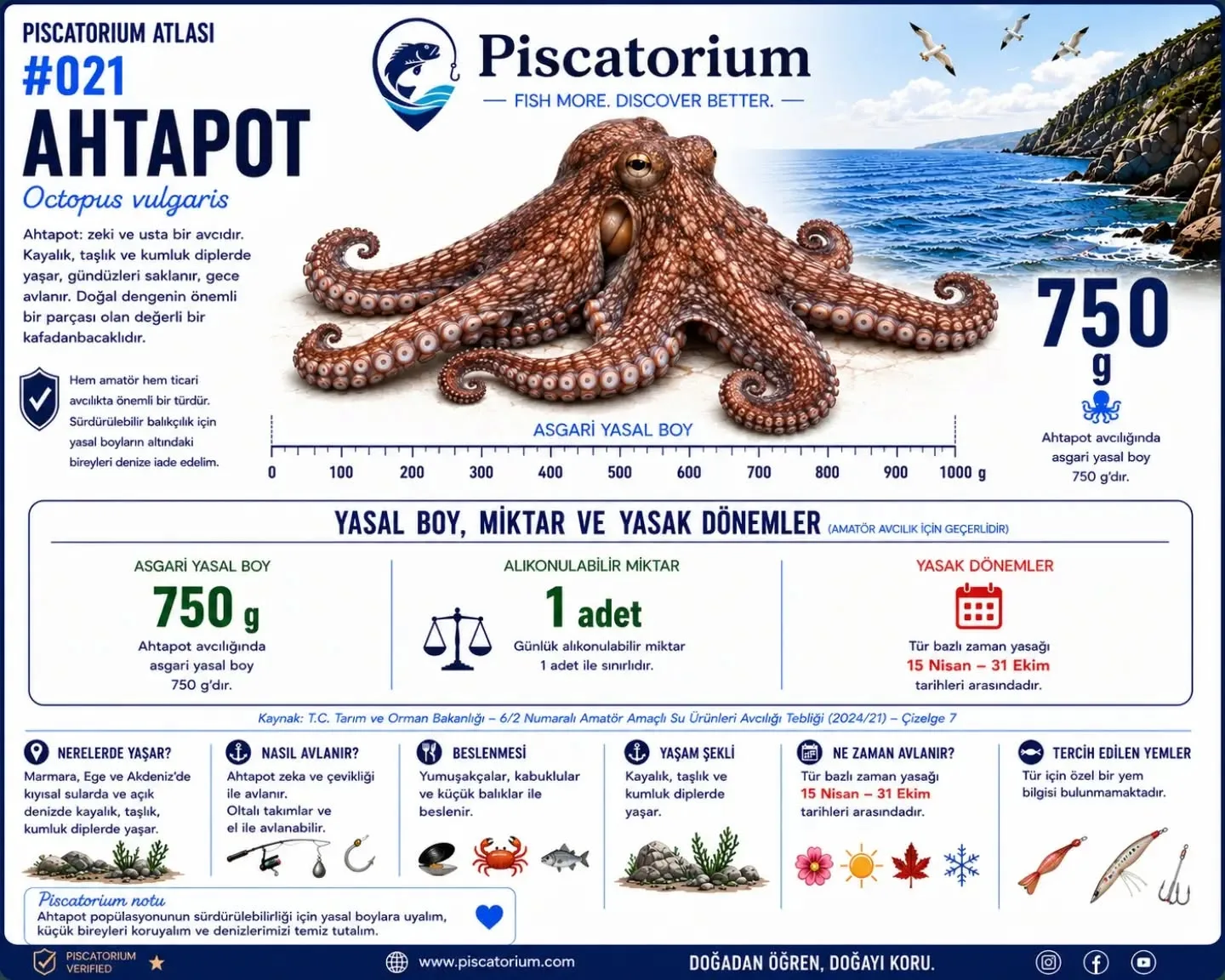
In recreational fishing, common octopus is off-limits from 15 April – 31 October; the fishing window opens on 1 November and closes on 14 April. The rule is written for the common octopus, scientific name Octopus vulgaris. In our catalogue this species is recorded along the Turkish coast for the Marmara, the Aegean and the Mediterranean.
Two limits also apply in the open months: the octopus must weigh at least 750 grams, and one person may take only 1 per day. Below you'll find the calendar, the weighing rule, how to tell an octopus from its look-alikes, and the seas where it is recorded.
The calendar: which part of the year is open?
The closed season is longer than half the year. An octopus caught between mid-April and the end of October goes back into the sea, whatever it weighs. Every octopus you meet on a rocky shore, under a jetty or while diving in summer falls inside this period; the open season falls in winter and early spring.
Most of the species limited to one per day in the communiqué have a closed season. Put the octopus next to these species and you can see how wide its calendar is:
| Species | Minimum size | Daily limit | Closed season |
|---|---|---|---|
| Common octopus | 750 g | 1 | 15 April – 31 October |
| Leerfish | 40 cm | 1 | 15 April – 15 May |
| Turbot | 45 cm | 1 | 15 April – 15 June |
| White grouper | 50 cm | 1 | 1 June – 31 August |
| Common dolphinfish | 50 cm | 1 | 1 January – 14 August |
The octopus ban starts on the same day as the leerfish and turbot bans but ends months after them. Some species on the list have an even longer closed season; the common dolphinfish is one of them.
The limit is in grams, not centimetres
For the octopus the minimum size is written as a weight rather than a length: 750 grams. An octopus that looks big with its arms spread can still fall below the limit on the scale; arm length is not a reliable clue to weight. That's why a small hand scale is useful for octopus fishing, not a tape measure.
When weighing, it is enough to put the octopus in a net or a bag and subtract the weight of the container. Since the animal carries water, it may read slightly heavy on the scale; if you doubt a weight close to the limit, the octopus should go back into the sea. The quantity limit works separately: the first octopus that reaches 750 grams fills your allowance for the day, and a second one cannot be kept, however heavy it is.
How it differs from the European squid, the common cuttlefish and the musky octopus
An octopus has eight arms; its body has no fins and no hard internal shell. The body of the European squid is long and arrow-shaped, with fins at the tip and two long tentacles between its arms. The cuttlefish, the common cuttlefish, has a flat body, a thin fin running around the body like a skirt, and a white, chalky bone on its back.
The real confusion comes with another octopus. On the musky octopus (Eledone moschata) the suckers sit in a single row on the arms and the animal carries a distinct musky smell; on the common octopus the suckers are in two rows. The 750 grams and the closed-season line in the communiqué are written for Octopus vulgaris. If you are not sure which species you are holding, the safest way is to follow the strictest rule.
Recorded seas and habitat
In our catalogue the common octopus is recorded in three Turkish seas: the Marmara, the Aegean and the Mediterranean. It has no record for the Black Sea; this sea, with its low salinity, is generally not considered a suitable environment for the octopus. Its ecological group is marked as rocky and bottom species, and its shore-fishing suitability as "medium".
In the entries for these three seas the month-by-month productivity, bait and technique information is still empty. The octopus is also not linked to individual fishing spots; the record stands at sea level. So there is neither a productivity calendar nor a province-by-province spot count here. For the octopus the calendar is set by the communiqué anyway.
Where and with what do you look for it?
The octopus lives on stony and rocky bottoms, in rock crevices and under stones. Mussel and crab shells piling up in front of its den are among the known signs that an octopus is nearby. It is generally known as an animal that is more active at night and at dusk and spends the day mostly in its den.
Recreational anglers mostly look for it with a hooked rig dragged slowly along the bottom, with a crab or a piece of white cloth tied on, or with a crab on the end of a line. Whichever method you choose, the number of hooks and lines you use is subject to the general provisions of the communiqué.
Why is the closed season so wide?
The octopus is a short-lived animal and its stock depends largely on each year's spawning. The female lays her eggs in a rock crevice and guards them until the young hatch; during this time she hardly feeds at all and often dies afterwards. Taking the female from the den in this period, which spreads over spring and summer, also means losing the eggs in that den.
The 750-gram limit is the second leg of the same logic: waiting for the animal to reach a size at which it can breed at least once. We explained the general reasoning behind the rule in the article what is the minimum legal size and why does it matter.
Last check before you go fishing
Three questions are enough for the octopus: is the date within 1 November – 14 April, does the animal reach 750 grams, and is your allowance for today still unused? If even one answer is "no", the octopus goes back into the sea.
Don't keep an octopus you are going to release out of the water for long, and don't try to tear its arms off by force; when you hold it close to the water, it loosens its suckers by itself. If a hook is caught, cutting the line short does the animal less harm than struggling to remove the hook.
The sizes and periods in this article come from recreational fishing communiqué no. 6/2; the official communiqué is the binding text, so check the current publication before you go fishing. The limits species by species are on the legal fish sizes page, and the species whose catch is entirely banned are in the article which fish are banned from fishing. The full species profile is on the common octopus species page.