















4 min read
Which fish are closed to fishing? The size and season table
53 fully protected species, 52 with a numerical size limit. Blackchin guitarfish, cushion coral, sea trout and the others.
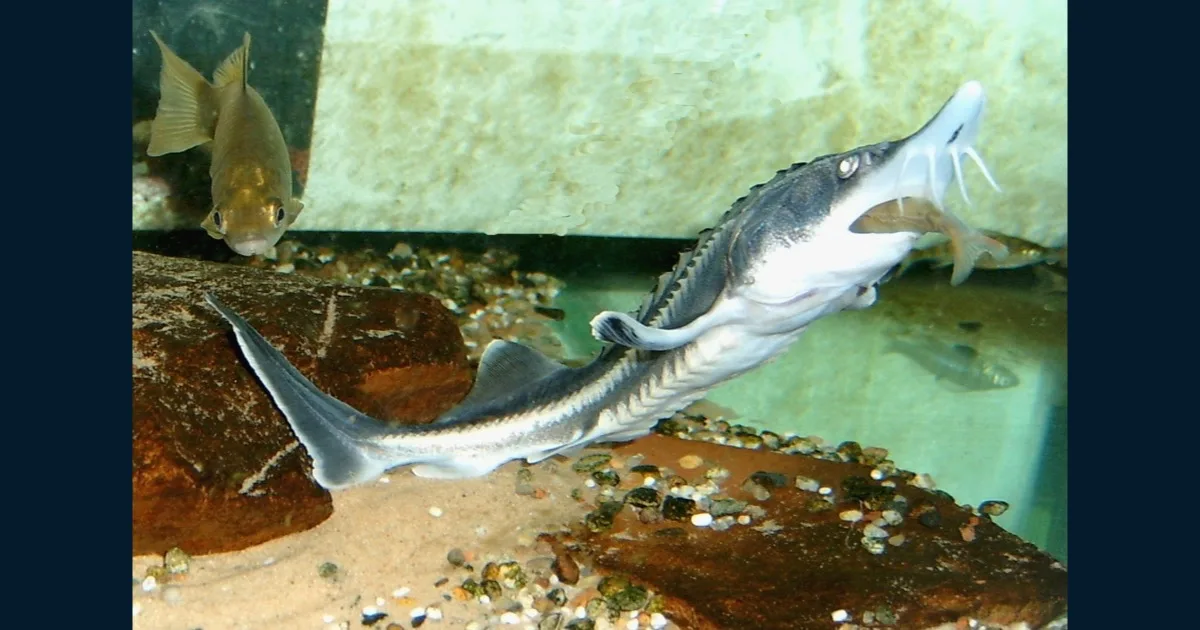
Let's start with the question people ask most: is it illegal to catch blackchin guitarfish? Yes. Both the blackchin guitarfish and the common guitarfish are on the list of species it is forbidden to catch; even if one ends up on your line, you can't keep it and must put it back in the water.
It isn't alone. The communiqué that regulates recreational fishing gives full protection to 53 species. On top of that there are three other kinds of rules: for some species there is a fishing ban in certain months of the year, for most species there is a minimum legal size and a daily quantity limit, and in some areas you can't fish at all, whatever the species. This article summarizes all four in one place.
Banned fish: 53 fully protected species
For these species the closed season is "all year"; in other words, there is no season to wait for. If one takes your bait, it must be released immediately and without harming it. The list falls into four groups:
- Sharks — seventeen species, including the thresher, tope shark, spiny dogfish, hammerhead, blue, sandbar, silky, angular rough, oceanic whitetip, great white and whale shark, as well as the porbeagle and shortfin mako.
- Rays and angelsharks — blackchin guitarfish, common guitarfish, spiny butterfly ray, mobulas, angelshark, sawback angelshark and smoothback angelshark.
- Fish — dusky grouper, European eel, sturgeons, beluga sturgeon, sea trout, Alakır trout, leopard barbel, Anatolian minnow, doctor fish, Batman banded loach and short-snouted seahorse.
- Other marine life — Mediterranean monk seal, dolphins and whales, sea turtles, noble pen shell, giant tun, common cerith, lamellariid sea snails, European spider crab, red sea star, cushion coral, red and false black coral, gorgonians, white gorgonian, commercial sponges and Neptune grass.
Most of the list consists of little-known species. We covered the sharks in Turkish waters and why they are protected in a separate article.
Fishing bans: species with a closed season
You can keep these species, but there is a fishing ban during their breeding season. A fish caught between the ban dates is released, whatever its size.
| Species | Fishing ban period |
|---|---|
| Atlantic bonito | 1 April – 14 August |
| Turbot | 15 April – 15 June |
| Leerfish and greater amberjack | 15 April – 15 May |
| White grouper | 1 June – 31 August |
| Common dolphinfish | 1 January – 14 August |
| Common sole | 1 February – 14 March |
| Common octopus | 15 April – 31 October |
| Swordfish | 15 February – 15 March and 1 October – 30 November |
| Atlantic bluefin tuna | 15 October – 15 June |
Fish with size and quantity limits
You can keep them, but undersized fish must be released. The minimum legal size is measured from the tip of the snout to the tip of the tail (to the fork of the tail for swordfish and tuna); the quantity limit shows the most one person may keep in a day.
| Species | Minimum size | Daily limit |
|---|---|---|
| Horse mackerel (Atlantic horse mackerel) | 12 cm | 5 kg |
| Mediterranean horse mackerel, whiting | 13 cm | 5 kg |
| Red mullet, striped red mullet | 12 cm | 5 kg |
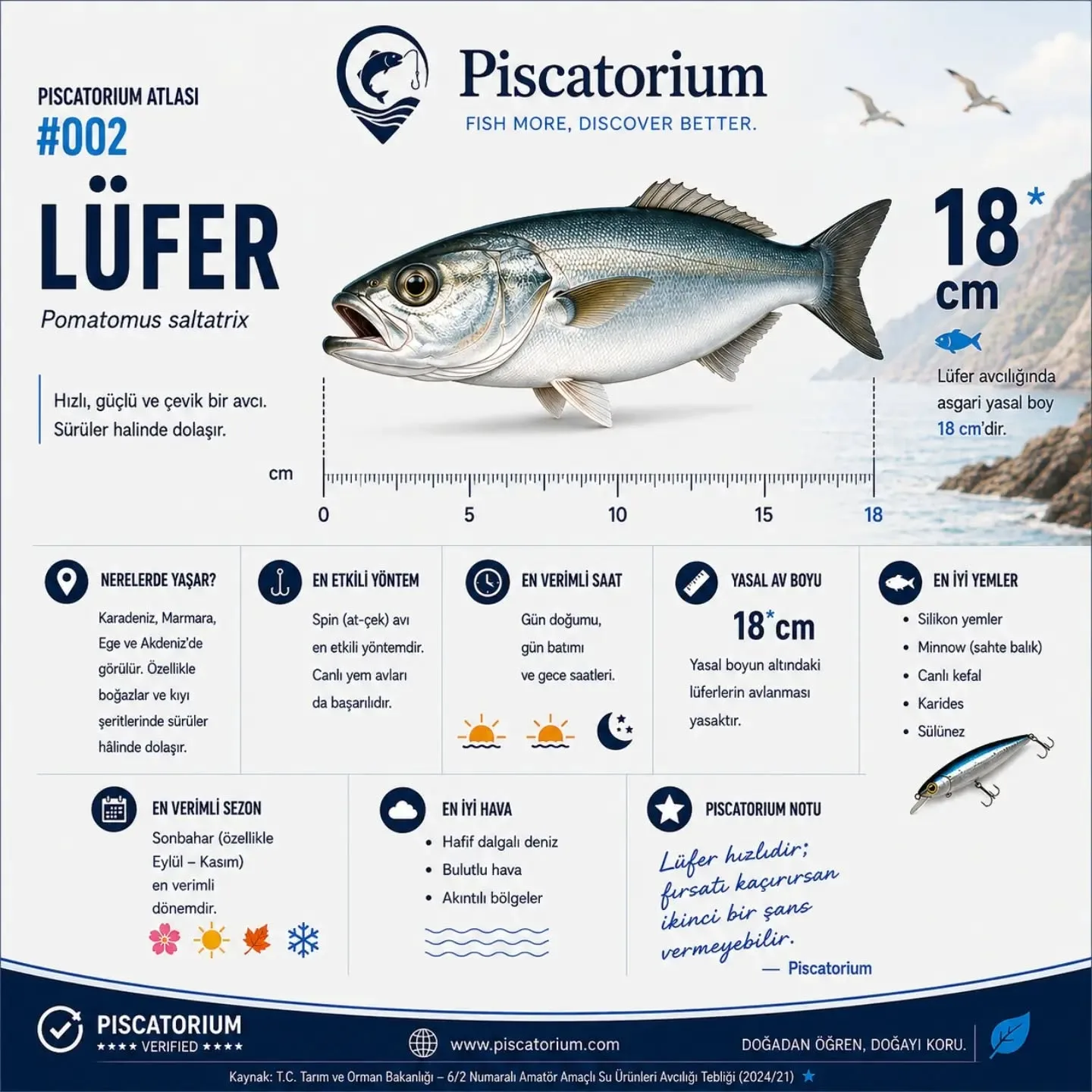
| Bluefish, Atlantic chub mackerel, common two-banded seabream | 18 cm | 5 kg |
| Gilthead seabream, Atlantic mackerel | 20 cm | 5 kg |
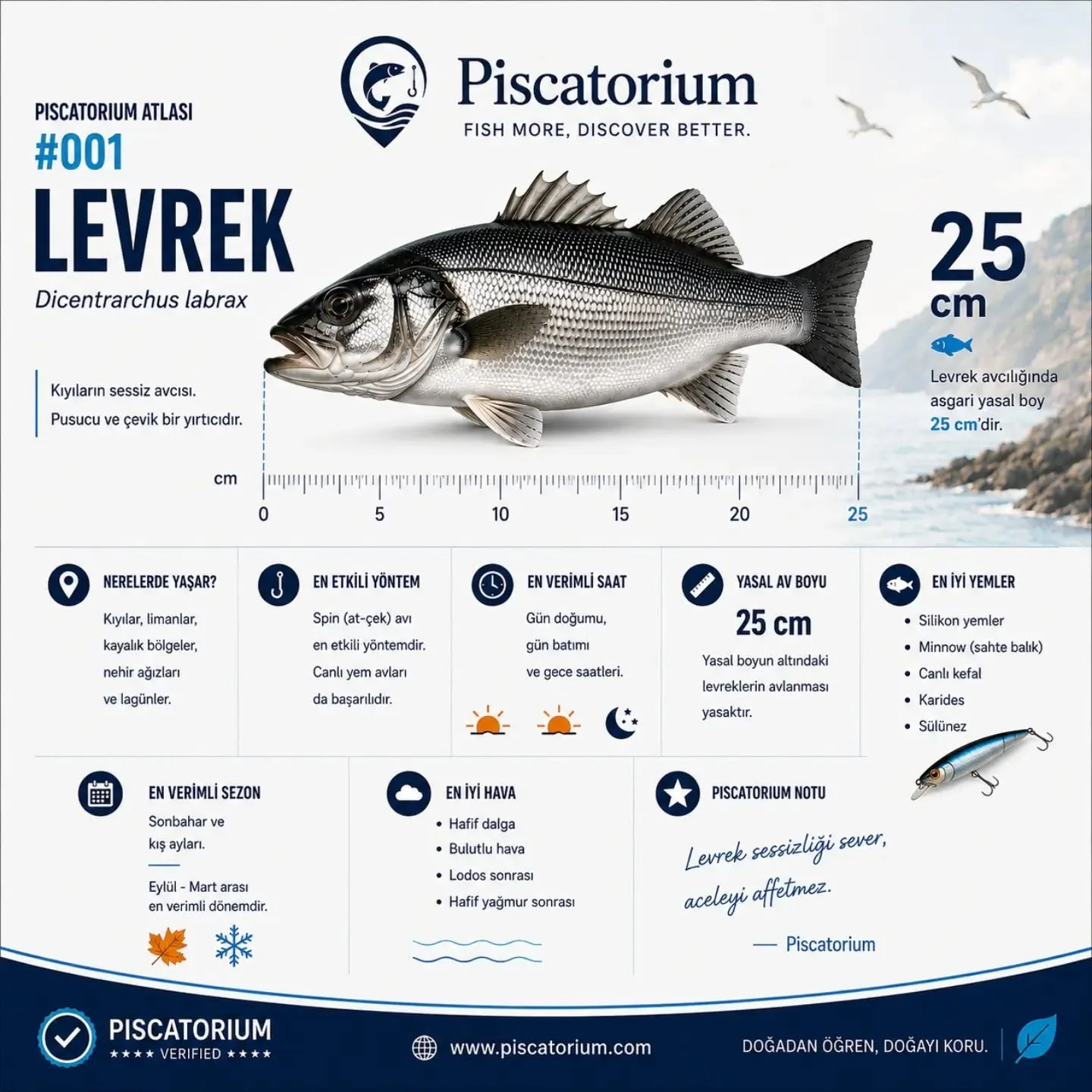
| European seabass, Atlantic bonito | 25 cm | 5 kg |
| Flathead grey mullet | 30 cm | 5 kg |
| Common dentex | 35 cm | 5 kg |
| Leerfish | 40 cm | 1 piece |
| Turbot | 45 cm | 1 piece |
| Shi drum | 45 cm | 5 kg |
| White grouper | 50 cm | 1 piece |
| Swordfish | 110 cm | 1 piece |
| Atlantic bluefin tuna | 115 cm | 1 piece |
| Common octopus | 750 grams | 1 piece |
The daily limit of 5 kg also applies to marine species not named in the table. Inland waters have a separate table: the minimum size is 90 centimeters for pikeperch and 40 for northern pike.
Area bans: places where the species doesn't matter
The communiqué also restricts fishing in 34 areas whose boundaries are defined one by one. In some of them every kind of fishing is banned, while in others only fishing from the shore with a rod is allowed. Harbor areas, military zones and special security zones also fall under this. To check whether there is such a restriction at the spot you're heading to, look at that spot's card on the map.
Why is there a size limit?
The numbers aren't arbitrary: they are set according to the size at which a species completes its first spawning. If a fish can be caught only after it has laid eggs at least once, the population renews itself. Taking a fish below the limit means that fish is gone without ever having reproduced. Closed seasons follow the same logic and protect the breeding months.
A practical rule for recreational anglers
- Don't keep a fish you don't recognize. Most of the banned species are little-known ones; "I didn't know what it was" is not an excuse.
- Carry a measuring tape. By eye you can't tell 40 from 45 cm.
- If you're going to release it, do it fast. Hold it with a wet hand and don't keep it out of the water for long.
- Watch the daily quantity limit. Even if the size is fine, the quantity limit applies separately.
- Check the date. The same fish can be allowed one week and banned the next.
For the current status by species, you can look at the species pages; each species' size, quantity and ban information is on its own page. We explained how the size limit is measured in the what is the legal size article.
This article is a summary. What is binding is the Ministry of Agriculture and Forestry's recreational fishing communiqué currently in force.