































4 min read
Leerfish: minimum size, closed season and tackle
The leerfish daily limit is a single fish. The 40 cm size, the 15 April – 15 May closed season, and spinning and shore jigging tackle.
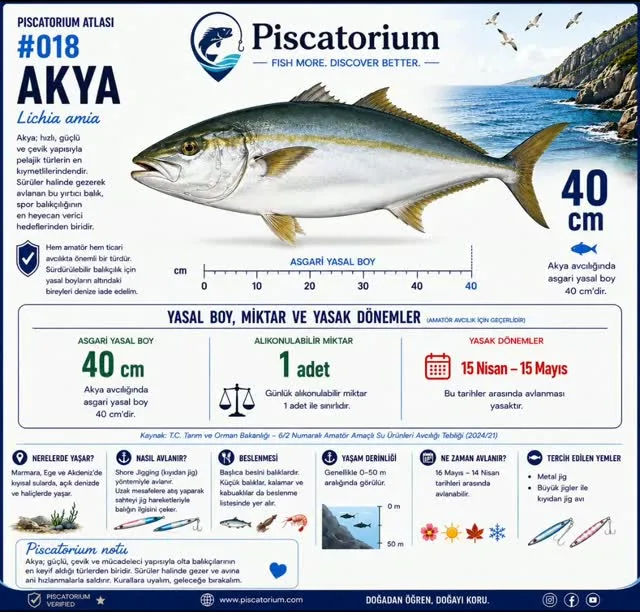
Leerfish (Lichia amia) is a large, fast predator of the Carangidae family; in our catalogue it is recorded along the Turkish coasts for the Marmara, the Aegean and the Mediterranean. For recreational fishing its minimum legal size is 40 cm, the daily limit is 1 fish, and the closed season is 15 April – 15 May. From shore it is usually targeted with spinning, shore jigging and live bait.
Getting to know the leerfish
The leerfish's body is laterally compressed and deep; its back is dark grey or olive, its sides and belly silvery. Its easiest distinguishing mark is the lateral line: it makes a clear curve above the pectoral fin and then runs down to the tail in a wavy line. Where the first dorsal fin would be, there are separate, short spines. Because its scales are very small, its skin looks smooth and shiny.
Our catalogue records two more local names for the leerfish: kuzu and liça. Its ecological group is marked as “pelagic predator” and its biogeographic status as “native/migratory”; in other words, it is not a fish that stays tied to the coast but one that moves after schools of prey.
Don't mix it up with the greater amberjack
A fish often confused with the leerfish is the greater amberjack (Seriola dumerili) of the same family. The confusion exists at the level of names too: in our catalogue, one of the local names of the greater amberjack is “big leerfish” (büyük akya). It isn't hard to tell the two species apart. On the greater amberjack you see a dark band running from the snout across the eye and slanting up toward the dorsal fin, and a yellowish stripe along the full length of the sides; its lateral line does not curve like the leerfish's but follows a straight line.
As for the rules, the two species are close but not the same. The closed season and the daily number are identical for both, while the minimum size differs:
| Species | Minimum size | Daily limit | Closed season |
|---|---|---|---|
| Leerfish (Lichia amia) | 40 cm | 1 fish | 15 April – 15 May |
| Greater amberjack (Seriola dumerili) | 30 cm | 1 fish | 15 April – 15 May |
A 35-centimetre greater amberjack may be kept; a leerfish of the same length has to go back into the water. For a fish you are unsure about, taking 40 centimetres as the basis is the safest way.
What does one fish a day mean?
For the leerfish the quantity is counted in fish, not in kilograms: 1 fish per person per day. The moment you keep the first leerfish that reaches the legal size, your leerfish allowance for that day is full; even if a bigger fish comes afterwards, it cannot be kept. Keeping a legal-size leerfish is not mandatory either; measuring the fish, taking a photo and releasing it is also within the rules.
The closed season lasts one month but falls right in the middle of spring. A leerfish caught between 15 April and 15 May is released back into the sea, whatever its size. The closed season of the turbot starts on the same date as the leerfish's; you can find all closed seasons in one table in the article which fish are banned from fishing.
Where to look for it?
In our catalogue the leerfish is recorded in three Turkish seas: the Marmara, the Aegean and the Mediterranean. There is no Black Sea entry. Its shore-fishing suitability is marked “medium”. In the entries for these three seas the productive months, bait and technique fields are still empty; the species has not been linked to individual fishing spots either. That is why there is no spot count or province list here.
According to general angling knowledge, the leerfish roams where schools of small fish gather: harbour and breakwater mouths, headlands with current, coasts where streams flow into the sea. Flathead grey mullet and Atlantic horse mackerel schools are counted among the leerfish's main prey; places where these schools come close to shore are places where the leerfish may also be nearby. Small fish suddenly scattering at the surface and leaping out of the water often show that a predator is cruising below.
When?
In our catalogue there is no monthly calendar for the leerfish in Turkish seas, so we cannot give a list of productive months. The only certain thing in the calendar is the communiqué: apart from 15 April – 15 May, the leerfish may be kept.
General angling accounts say that the leerfish comes closer to shore in the months when the water warms up, and in autumn becomes active following the migrating schools. Read this not as a calendar backed by data but as a rough framework. During the day, first light in the morning and the hours around sunset are the times often mentioned for the leerfish.
Tackle: spinning, shore jigging, live bait
The leerfish is a large, powerful fish that tries to rub against rocks or the breakwater as it runs. So the tackle is chosen accordingly: a sturdy rod able to make long casts, a reel with a reliable drag system, braided main line and a thick fluorocarbon leader that resists abrasion. Spoons, metal jigs, minnows and surface lures are used as artificial lures.
In shore jigging, the metal lure is cast far and left to sink to the bottom or the desired depth, then pulled up with sharp rod strokes and fast winding. In spinning, a minnow or surface lure is passed over the school to imitate a fleeing small fish. In both, not tightening the reel's drag too much on the leerfish's first run prevents the line from breaking.
In fishing with live bait, a small flathead grey mullet or Atlantic horse mackerel is hooked and left to the current. There is a rule that is often overlooked here: the bait fish is also subject to its own size limit. The limit is 12 centimetres for the Atlantic horse mackerel, 30 for the golden grey mullet and 20 for other mullets; a fish below that cannot be kept even as live bait.
Following the rules and releasing
Don't keep a leerfish you are going to release out of the water for long, handle it with wet hands and remove the hook quickly with pliers. When releasing a tired fish, holding its head into the current and waiting a few seconds helps it recover and swim away.
The size, number and season in this article come from the recreational fishing communiqué no. 6/2; the binding text is the official communiqué, so check the current publication before going fishing. The limits for all species are on the legal fish sizes page. The full profile of the species is on the leerfish species page.