



























4 min read
Red mullet: where, when and with what bait?
Two bottom fish of the same genus: red mullet and striped red mullet. Which months are productive in which sea, which bait works, and the minimum legal size in cm.
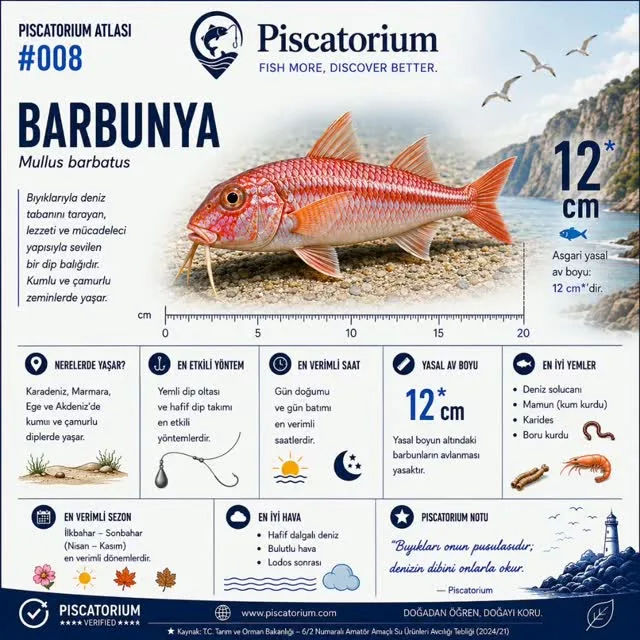
Red mullet (Mullus barbatus) and striped red mullet (Mullus surmuletus) are two bottom fish of the same genus, both with two long barbels under the chin. In our catalog both are recorded in the Black Sea, the Marmara, the Aegean and the Mediterranean, and their minimum legal size is the same: 12 centimeters. Where they differ is the bottom type, the calendar and the number of spots linked to the shore.
Same family, two different fish
Both species belong to the Mullidae family. In our catalog the local names of the red mullet are “Barbun” and “Barbunya”, and those of the striped red mullet are “Tekir” and “Çizgili barbun”. On the shore people sometimes call both fish barbun; in this article barbunya means M. barbatus and tekir means M. surmuletus.
The barbels do the same job in both species: the fish sweep them through sand and mud to find small crustaceans and worms. That is why both feed on the bottom, and your bait needs to stay on the bottom.
Look at the face: forehead profile
The easiest way to tell them apart is the head profile. The red mullet’s forehead drops steeply, almost vertically. In the striped red mullet the profile is more sloped and the snout looks longer.
Look at the back: first dorsal fin
The first dorsal fin of the striped red mullet carries dark and yellowish bands, and yellowish lines running lengthwise along the sides are easy to spot; the name “çizgili barbun” (striped mullet) comes from this. The red mullet’s first dorsal fin is plain and unstriped, and its body is a more uniform pink-red.
Mud or rock? Bottom type and recorded spots
Our catalog places the two species on different bottoms. The red mullet’s habitat is sandy and muddy bottom, the striped red mullet’s is sandy-rocky bottom. Shore fishability separates accordingly: “medium” for the red mullet, “high” for the striped red mullet. The shoreline where rock blends into sand is striped red mullet territory; flat mud bottom belongs to the red mullet.
The spot records sharpen the difference even more. The striped red mullet is linked to 311 spots on the Turkish coast: Black Sea 156, Marmara 110, Aegean 24, Mediterranean 21. In the provincial ranking İstanbul leads with 62 spots, followed by Kocaeli 24, Tekirdağ 23, Çanakkale 21, Balıkesir 17 and Düzce 15.
For the red mullet the picture is a single line: in our catalog it is linked to only one spot, and that one is on the Black Sea coast, in Artvin. This number does not mean the red mullet is rare; our catalog has simply not yet linked the species widely to shore spots. As general knowledge, the flat mud bottom the red mullet likes is often far from the shore, at depths reached by boat. The spot count measures not abundance but at how many spots the species is recorded.
In which months is it recorded?
| Sea | Red mullet | Striped red mullet |
|---|---|---|
| Black Sea | Year-round | Year-round |
| Marmara | April – November | Year-round |
| Aegean | April – November | Year-round |
| Mediterranean | March – October | Year-round |
The striped red mullet is recorded year-round in all four seas. The red mullet’s calendar, on the other hand, closes for winter outside the Black Sea: April to November in the Marmara and the Aegean, March to October in the Mediterranean. The Mediterranean window opens a month earlier and closes a month earlier than in the other two seas. December, January and February are filled in for the red mullet only in the Black Sea row.
If you want to see the two species side by side month by month in the Marmara, see the article which fish is caught in which month in the Marmara; the striped red mullet is among the species recorded there year-round.
Bait and technique: small bites on the bottom
The bait lists are very close to each other. For the red mullet the natural baits recorded are shrimp, tube worm and mamun, for the striped red mullet shrimp, worm and mamun; for both species the artificial lure is a single item: silicone worm. The fishing technique in the species records is also shared: bottom fishing and LRF.
Differences show up in the sea rows. For the red mullet, the Marmara, Aegean and Mediterranean rows give “shrimp / silicone worm” as bait and bottom fishing and LRF as technique; in the Black Sea row, however, the bait is sülünez and the technique is surf casting. In all four sea rows of the striped red mullet, the bait is written as sülünez and the technique as surf casting. The regional supporting baits follow the same pattern in both species: European anchovy, Atlantic horse mackerel and shrimp in the Marmara; European anchovy and European sprat in the Black Sea; European sardine, mamun and sülünez in the Aegean; European sardine, European squid and shrimp in the Mediterranean.
The practice known on the shore is built around the small mouth of both species. A thin leader, a small hook and a small piece of bait that fully covers the hook work well; the fish will nibble away a big bait before it reaches the hook. That is why it matters to peel the shrimp and cut it into small pieces, and to keep worm baits short. On the LRF side, a silicone worm mounted on a light jig head is worked by dragging it along the bottom or with short hops. Because the bite is trembling and quick, a fine-tipped rod is an advantage.
If you are looking for striped red mullet from the shore, look at the edges where rock meets sand, inside harbors, and the sandy gaps around pier legs. Casting your rig straight onto the rock snags the hook on stone; dropping it onto the sand right in front of the rock protects both your rig and your time. For the red mullet, since it needs flat, soft bottom, most anglers go out by boat and use a bottom rig that slowly scans the seabed.
The rule is the same for both
| Species | Minimum legal size | Daily limit | Closed season |
|---|---|---|---|
| Red mullet (Mullus barbatus) | 12 cm | 5 kg | — |
| Striped red mullet (Mullus surmuletus) | 12 cm | 5 kg | — |
Basis: the recreational fishing communiqué no. 6/2, 2024/21 Table 7. No species-specific time ban is stated for either species; area and method provisions still apply. Even if you can’t tell the species apart, the limit doesn’t change; this is one of the rare cases where red mullet and striped red mullet make things easier for you. Still, the table is a summary: the official communiqué is the binding text, so don’t forget to check the current publication before you fish. All species are on the legal fish sizes page, and how to measure is in the article what is the legal size.
Small fish are common with these two species. Handle a red mullet or striped red mullet under 12 centimeters with a wet hand, remove the hook without forcing it and release it into the water right away. The sea-by-sea month tables and bait records for both species are on their own pages: red mullet and striped red mullet.