































4 min read
Flathead grey mullet: what size, and what bait?
The communiqué splits the mullets into three and gives each its own size. Which limit applies to the flathead grey mullet, and in what conditions does it come inshore?
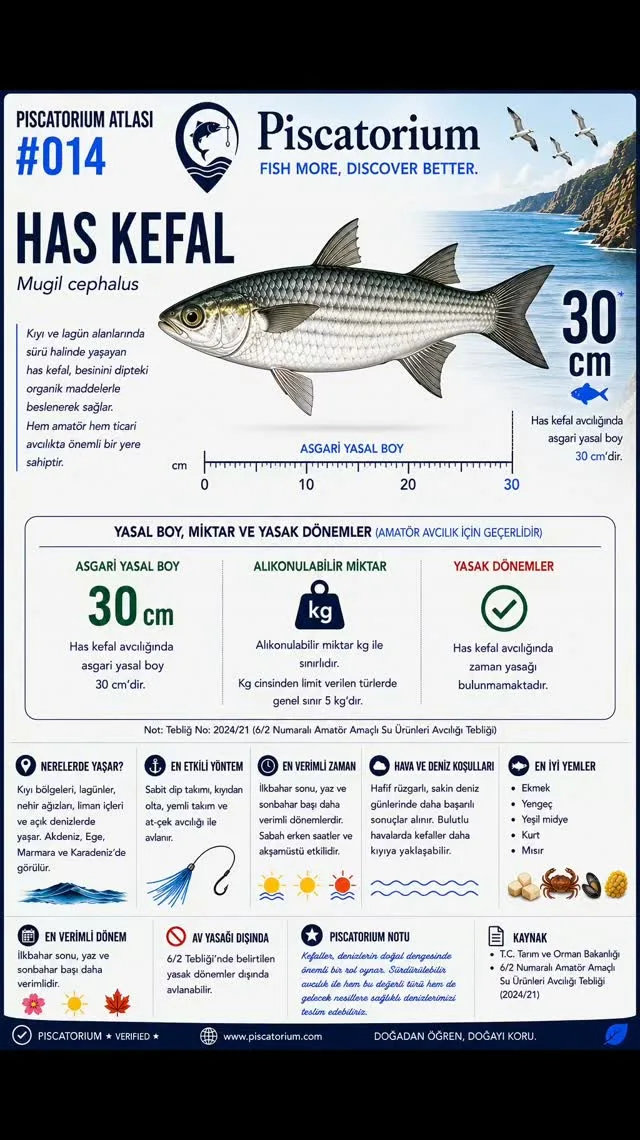
For flathead grey mullet (Mugil cephalus) the minimum legal size for recreational fishing is 30 cm, with a daily limit of 5 kg. Its recorded main bait is bread crumb, and the techniques are Bolognese, float and bottom fishing. It is marked as productive year-round in all four of Turkey's seas; in our catalogue it is a coastal fish recorded at 463 fishing spots.
Three separate mullet rows in the communiqué
The question "How many cm does a mullet need to be?" has no single answer. The communiqué splits mullets into three rows and gives each its own minimum size. The one that corresponds to the flathead grey mullet is the row with the scientific name Mugil cephalus:
| Row in the communiqué | Scientific name | Minimum size | Daily amount |
|---|---|---|---|
| Flathead grey mullet | Mugil cephalus | 30 cm | 5 kg |
| Amur mullet | Planiliza haematocheilus | 35 cm | 5 kg |
| Other mullets | Chelon labrosus, Chelon ramada, Chelon saliens, Oedalechilus labeo | 20 cm | 5 kg |
None of the three rows has a species-specific closed season; the area and method provisions, however, apply year-round. The practical result: a 25-centimetre mullet may be legal to keep or may have to go back, depending on the species. Before measuring, you need to work out which mullet it is.
How do you recognise a flathead grey mullet?
The most distinctive feature of the flathead grey mullet is its eye. A thick, transparent layer of fat covers the front and back of the eye, so the eye looks sunk into this membrane. The head is broad and flat, the body stocky, and thin dark lines running lengthwise along the sides are visible. The local names recorded in our catalogue are topan kefal, topan, kefal and has kefal; the name "topan" is used especially for large individuals.
In the other mullets this fatty eyelid is either absent or very weak. The Amur mullet is of Far Eastern origin, known as a species that settled in the Black Sea later, and it has the highest limit. For a large mullet whose species you cannot be sure of, the safest course is to go by the highest limit in the table, 35 centimetres.
Where: harbours, lagoons, river mouths
The flathead grey mullet is recorded in our catalogue with the habitat "harbour, lagoon, river mouth"; its environment is sea and brackish water. Its suitability for shore fishing is marked "high": it is a fish of the coastal band where fresh water mixes into the sea and salinity drops. The distribution of the fishing spots where it is recorded, by sea:
- Black Sea — 204 spots
- Marmara — 104 spots
- Aegean — 81 spots
- Mediterranean — 74 spots
The concentration in the Black Sea is striking: our catalogue has 392 sea and coastal spots in this sea, and the flathead grey mullet is recorded at more than half of them. In Marmara it is recorded at 104 of 398 spots, in the Aegean at 81 of 377, and in the Mediterranean at 74 of 295. This ratio measures how widespread the fish is, not how abundant: it shows that it is recorded at a spot, not how many are caught there.
At the provincial level, the place with the most records is İstanbul: it is recorded at 42 spots. It is followed by Antalya with 38, Çanakkale with 37, Balıkesir with 31, Samsun with 30 and İzmir with 27 spots. The provincial list also spans all four seas: Samsun from the Black Sea, İzmir from the Aegean, Antalya from the Mediterranean, and İstanbul and Çanakkale from the two straits.
When?
The calendar is short here: the flathead grey mullet is recorded year-round in all four seas. It is not a fish you wait a season for; the real variables are weather and water. General fishing lore describes the mullet as a fish of calm, wave-free days; when the sea gets rough, harbour interiors and sheltered coves come to the fore. For the measures to check before heading out, you can read which three numbers to check before going out to sea.
What it is caught on: bread crumb first
In the rows for all four seas the main bait is the same: bread crumb. The natural bait list is bread, worm and shrimp; on the lure side only small silicone is recorded. Regional supplementary baits vary by sea: in the Black Sea European anchovy and European sprat, in Marmara European anchovy, Atlantic horse mackerel and shrimp, in the Aegean European sardine, mamun and sülünez, in the Mediterranean European sardine, European squid and shrimp.
Bread crumb is kneaded with a little water into a firm dough and wrapped around the hook; if it is too soft it falls apart the moment it hits the water. Because the mullet is a wary fish, small hooks and thin line are used. Bread crumbs crumbled into the water help gather the shoal at one spot; throwing in a little at a time, often, keeps the shoal close without filling it up.
Technique: Bolognese and float
The technique recorded in the sea rows is Bolognese, and float and bottom fishing are listed as general fishing techniques. Bolognese is a method that combines a long telescopic rod with a reel and guides with a sensitive float. The bait stays suspended at a set depth beneath the float and drifts naturally with the current.
A mullet's bite is often not hard; the float dips slightly, slides sideways or stops for a moment. To catch this small movement you need to adjust the float so its tip sits just above the water. The bottom rig is useful at stream mouths, in places where a float cannot hold in the current.
Measuring and releasing
The mullet is a slippery and strong fish; if it slips from your hand and falls onto a dry surface it loses its scales and its protective layer. When measuring, hold it with a wet hand, lay the fish on a wet surface and measure from the tip of the nose to the tip of the tail. It is impossible to tell 28 from 30 centimetres by eye; a tape measure on the pier or a bucket with centimetre markings makes the job easier.
Put a flathead grey mullet under 30 centimetres back in the water without wasting time. In a place where small mullets keep coming one after another, going up a hook size reduces how often the small fish get hooked.
The basis of the rule
The size and quantity values are from the recreational fishing communiqué numbered 6/2; the official communiqué is the binding one, so check the current publication before going fishing. The limits for all species are on the legal fish sizes page. The mullet's records by sea and its spots are on the mullet species page.