





















4 min read
When is turbot caught, and what is the minimum legal size?
In our catalog it is recorded in only two seas: the Black Sea and Marmara. A two-month ban falls right in the middle of its productive months.
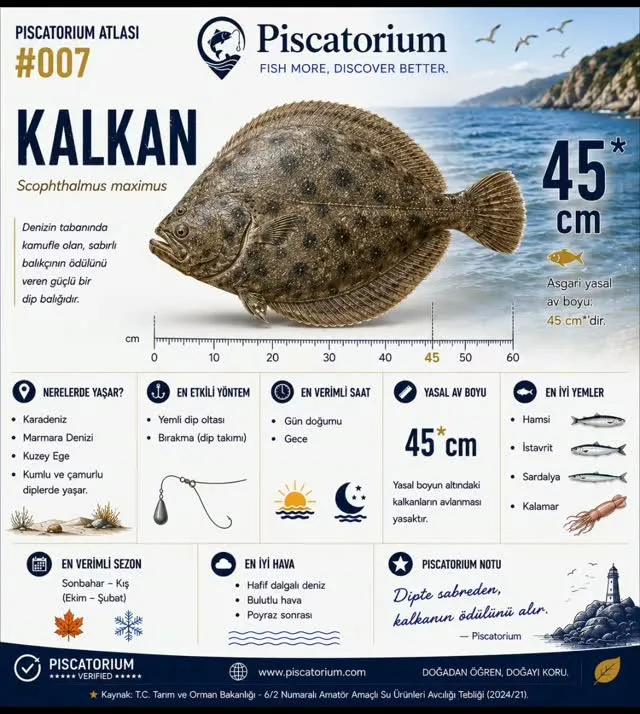
Turbot (Scophthalmus maximus) is a large flatfish that lives on sandy depths; in our catalogue it is recorded only in the Black Sea and the Marmara, and one of its local names is "Karadeniz kalkanı". The communiqué sets three limits on this species at once: a minimum legal size of 45 cm, 1 fish per day, and a closed season from 15 April to 15 June.
The calendar and the ban overlap
The month-by-month data for each sea has two rows, and the two rows are not the same. The closed season also falls right in the middle of these months:
| Sea | Productive months | Part that falls in the closed season |
|---|---|---|
| Black Sea | November – January, March – June | Second half of April, May, first half of June |
| Marmara | February – May, October – December | Second half of April, May |
February is not marked in the Black Sea row; the calendar runs in two parts, from November to January and from March to June. In the Marmara the season stretches from February to May and from October to December. July, August and September are empty in both seas.
Once you subtract the ban, the remaining window becomes clear. In the Black Sea, November, December, January, March and the first half of April are open; when the closed season ends, the second half of June also falls within the recorded months. In the Marmara, February, March, the first half of April, and October, November and December are open; in this row June is not marked as productive anyway. In both seas May is entirely out. In short, according to the catalogue, the turbot is a fish you look for from late autumn to mid-spring.
Recognizing the turbot: round body, bony tubercles
The turbot is one of the flatfish whose eyes sit together on the left side of the body. Its body is almost round; the eyed upper side is in brown-grey tones that match the sand, and the underside is white. There are no scales on the upper side; instead there are bony tubercles embedded in the skin, and this hard surface is what gives the fish its name. Our catalogue places the species in the Scophthalmidae family and in the "sandy/benthic" ecological group: an ambush predator that spends its life pressed to the bottom, buried in the sand.
The fish most often confused with it along the shore is the common sole. The common sole is long and oval, has a small mouth and no tubercles. Its limits are different too: the minimum size is 20 cm, and after the 16 September 2026 amendment the closed season is 1 February – 14 March. The turbot also has close relatives; the communiqué writes the turbot line not for a single species but for the whole genus as Scophthalmus spp. So whichever species of the genus you catch, the rule of 45 cm, 1 fish and 15 April – 15 June applies.
No spot records, low shore share
The turbot is a species not yet linked to any shore fishing spot in our catalogue. For this reason we cannot give a spot count by province or by sea; the only geographic information we have is the month rows of the two seas. For an overview of the two recorded seas you can look at the Karadeniz and Marmara pages.
The record also holds an explanation for this: the turbot's catchability from shore is marked as "low", and its habitat is sandy depth. General fishing knowledge points in the same direction; the turbot is mostly caught from a boat, with bottom rigs set on sandy, deep ground. Those who want to try their luck from shore turn to long-cast surf rigs on beaches that drop quickly into deep water.
Bait: anchovy, horse mackerel, whiting
In the species record the natural baits are listed as European anchovy, Atlantic horse mackerel and whiting, and the artificial bait as a single item, large bottom soft lure. The technique is the same in both seas: bottom and surf. The featured bait in the sea rows is also common: "anchovy / large bottom soft lure".
The regional supporting baits differ on the two coasts: in the Black Sea anchovy and European sprat, in the Marmara anchovy, horse mackerel and shrimp. The notable thing about the list is that all three natural baits are the fish's own prey. The turbot is a predator that waits on the bottom and catches the small fish passing in front of it; this is why it matters for the bait to look still and natural on the bottom.
When choosing your bait fish, take its rules into account too. For horse mackerel (Atlantic horse mackerel) the minimum size is 12 cm, for whiting 13 cm; an undersized fish cannot be kept even for use as bait. A turbot rig is usually built with a heavy sinker, a thick leader and a large hook. The fish takes the bait slowly and surely; there is no need to rush the strike.
Three rules together
| Rule | Turbot (Scophthalmus genus) |
|---|---|
| Minimum size | 45 cm |
| Daily limit | 1 fish |
| Closed season | 15 April – 15 June |
Basis: recreational fishing communiqué no. 6/2, 2024/21 Table 7. The daily limit is by count, not by kilos: one turbot per person per day. In the closed season the fish goes back into the water whatever its size; a fish under 45 cm does too. The turbot matures late, and that is the reason the limit is high.
Why is the closed season in spring?
The ban sitting in spring is no coincidence. As general knowledge, the turbot approaches shallower water in spring to spawn; the period when the fish is closest to shore, and therefore easiest to catch, is also the period when it lays its eggs. By closing this window the communiqué leaves room for the stock to renew itself. That April, May and June are marked productive in the catalogue's Black Sea row fits this approach too; but a productive month does not mean a month when fishing is allowed.
If you catch a turbot in the closed season, or one that does not meet the size, keep the fish out of the water as little as possible. The tubercles on the upper side are hard; holding it with a wet cloth or a glove protects both your hand and the fish's skin. If the hook is deep, cutting the line short and letting it go does less harm than struggling to remove it.
The numbers here are a summary; what is binding is the official communiqué, so check the current publication before you fish. All species with a closed season are in the which fish are banned article, and the size limits are on the legal fish sizes page. The month table and bait records for both seas are together on the turbot species page.