
























4 min read
Common pandora: where, when and with what bait?
April – November in Marmara and the Aegean, March – October in the Mediterranean. A bottom fish recorded in three seas, with a 15 cm minimum size.
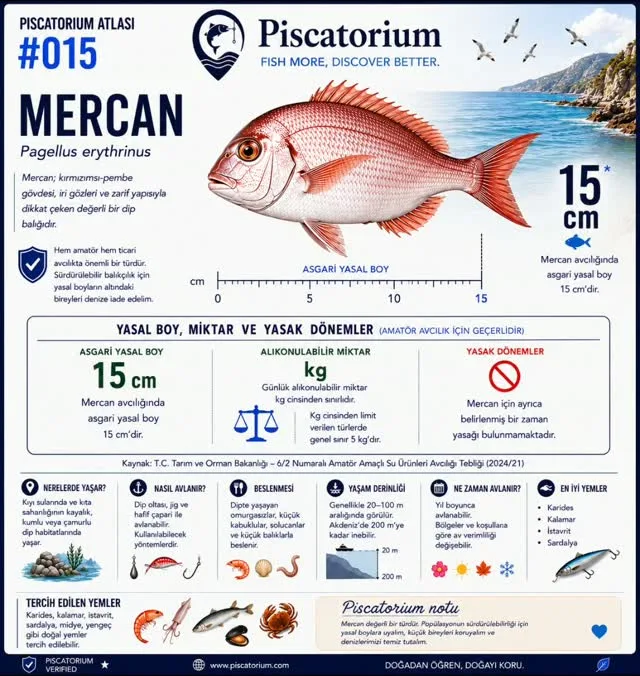
Common pandora (Pagellus erythrinus), called "kırma mercan" in the communiqué, is a bottom fish recorded in our catalogue for the Marmara, the Aegean and the Mediterranean. The months marked as productive are April – November in the Marmara and the Aegean, and March – October in the Mediterranean. Its recorded natural baits are shrimp, European squid and European sardine; among artificial lures, the kabura jig and the inchiku stand out.
The fish "mercan" and the one that isn't
First we have to clear up the confusion over the name. This article is about a fish of the Sparidae family: a bottom fish with a pink-red body, small blue spots scattered along the upper part of its back, and large eyes. Its local names recorded in our catalogue are "mercan" and "kırma mercan"; the communiqué lists the species as "Kırma (Kırmızı) mercan".
There is also an animal called "mercan" in the sea, meaning coral: red coral (Corallium rubrum), a coral species that lives attached to rocks. Protected corals are among the species whose catch is completely banned in the communiqué; the size and quantity rule in this article has nothing to do with them. Because they share the same name, the two are often mixed up in searches.
Telling it apart from similar fish
Two relatives of the common pandora from the same genus can be mistaken for it. Axillary seabream (Pagellus acarne) is paler, silvery pink, and has a distinct dark spot at the base of its pectoral fin. Blackspot seabream (Pagellus bogaraveo) has very large eyes and a dark spot at the start of its lateral line, behind the gill cover. The common pandora itself has neither of these spots; the blue spots on its back are the easiest way to tell it apart.
The 15 cm limit in this article is written for Pagellus erythrinus; check the rules for its relatives separately in the communiqué. If you are not sure which "mercan" you have caught, identify the species before measuring, and if you can't, go by the stricter rule.
In which months is it productive?
| Sea | Months marked as productive |
|---|---|
| Marmara | April – November |
| Aegean | April – November |
| Mediterranean | March – October |
There is an eight-month window in all three seas; in the Mediterranean this window opens a month early and closes a month early. December, January and February are not marked as productive in any sea. According to this record, the common pandora is a fish of the months when the water is warm.
The window also covers the busiest months of the monthly count in our catalogue. The number of productive species is at its yearly peak in the Aegean in October with 71, and in the Mediterranean in September with 70; both months fall in the period when the common pandora is marked as productive. So it is no surprise that someone waiting for common pandora over a rocky bottom gets other species on the line in the same period. The article which fish to catch in which month in the Marmara shows month by month which other species become active in the Marmara in these same months.
Where: rocky/sandy depths
The recorded habitat of the common pandora is rocky/sandy depths, and its ecological group is bottom species (demersal). That is, neither fully rocky nor fully sandy: somewhat deeper stretches where the rocky bottom turns into sand. Its shore catchability is marked as "medium": on coasts that drop quickly into deep water it can be reached from the shore, but it is often easier to look for it from a boat.
It is recorded in three Turkish seas in our catalogue: the Marmara, the Aegean and the Mediterranean. There is no record of common pandora for the Black Sea. The species has not yet been linked to individual fishing spots; the record stands at the sea level, so we can't give a spot count province by province. Looking at the depth contours on the map makes it easier to find the stretches where the rocky bottom turns to sand and to choose where to head, from the shore or from a boat.
Bait: shrimp first
In the rows for all three seas, the main bait is written as "shrimp / kabura jig". The natural bait list is the same trio everywhere: shrimp, European squid and European sardine. The regional supporting baits, which vary by sea, are as follows:
- Marmara — European anchovy, Atlantic horse mackerel, shrimp
- Aegean — European sardine, mamun, sülünez
- Mediterranean — European sardine, European squid, shrimp
Because the common pandora's mouth is small, you need to cut the bait small too. A piece of peeled shrimp or a thin strip of European squid works better when it is threaded on without leaving the hook tip exposed.
Technique: bottom and light jig
Two techniques are recorded: bottom and light jig. On a bottom rig the sinker is at the very bottom and the baited droppers work just above the seabed; since the fish feeds close to the bottom, you shouldn't lift the bait too far off the floor.
Two kinds of artificial lures are recorded. The kabura is a lure with a heavy lead head and a thread or silicone skirt and small hooks attached behind it; you let it down to the bottom and reel it in slowly. The inchiku consists of an octopus skirt attached to a long metal body; you lift it from the bottom with short jerks and let it drop. Both are used with a light jig setup, that is, a thin rod and braided line.
The common pandora is often a fish that comes small and in numbers. If fish below the limit keep coming one after another, going up a size in hook and bait reduces the catch of small fish; if that doesn't work either, moving to another spot is better than insisting on the same one.
Legal size: together with species of the same family
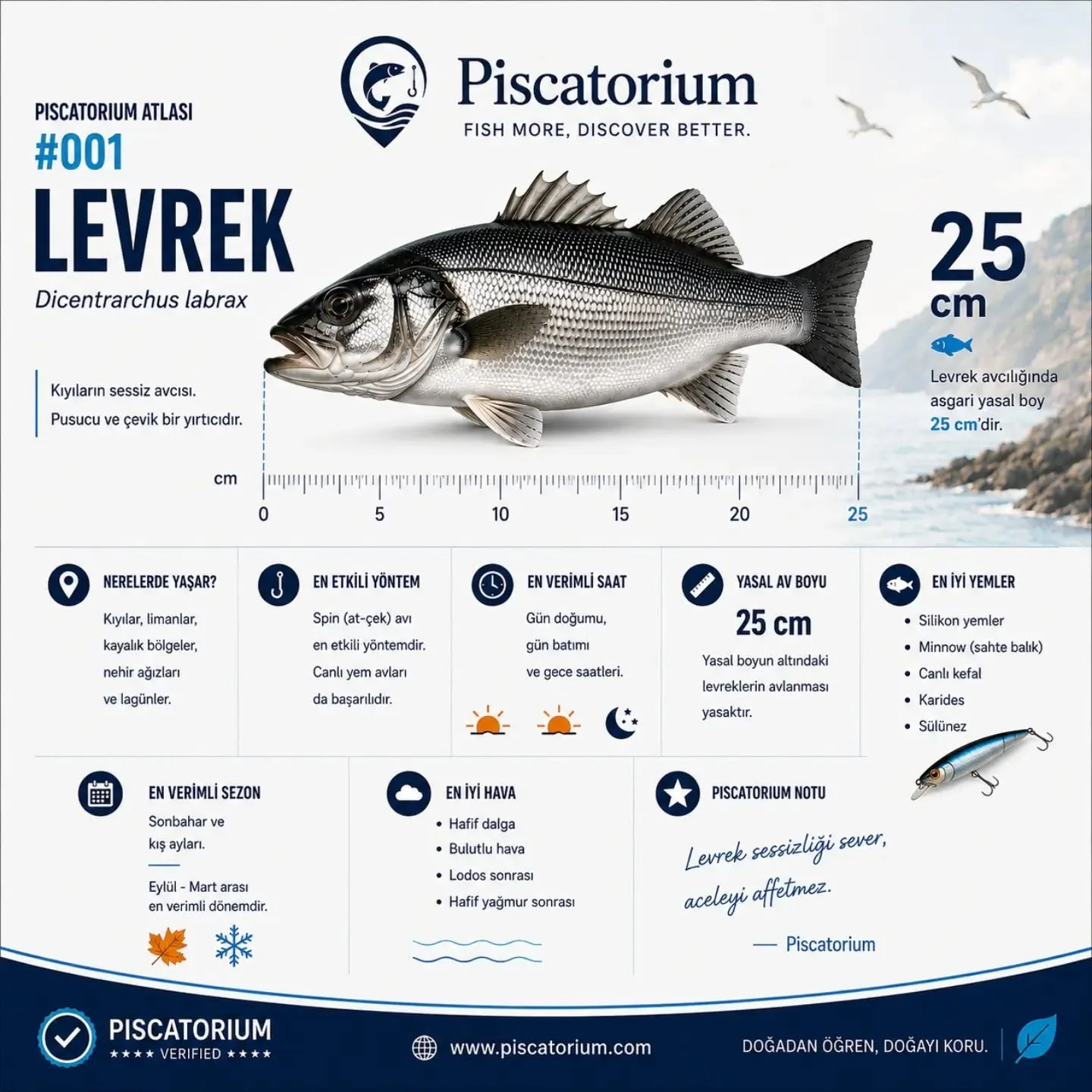
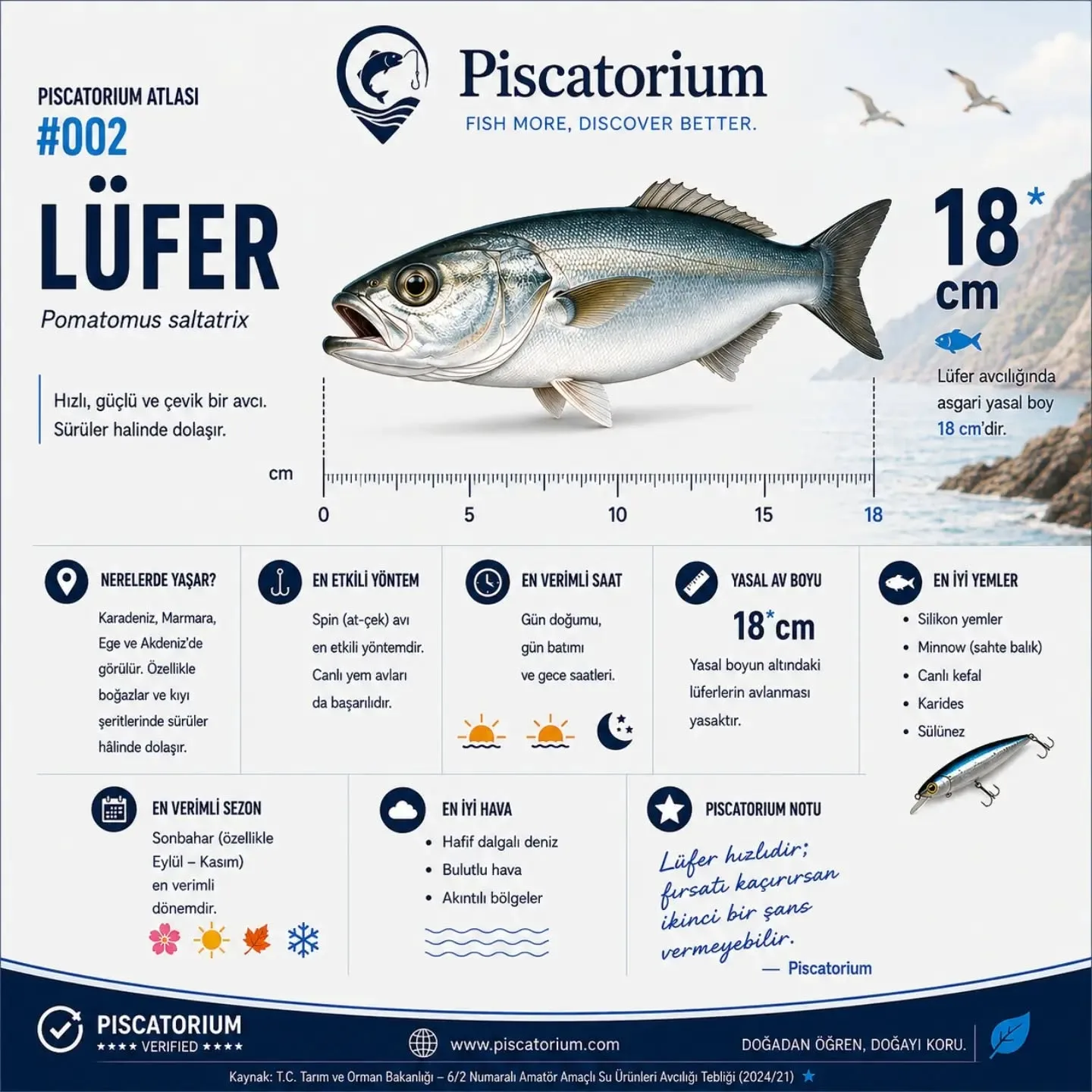
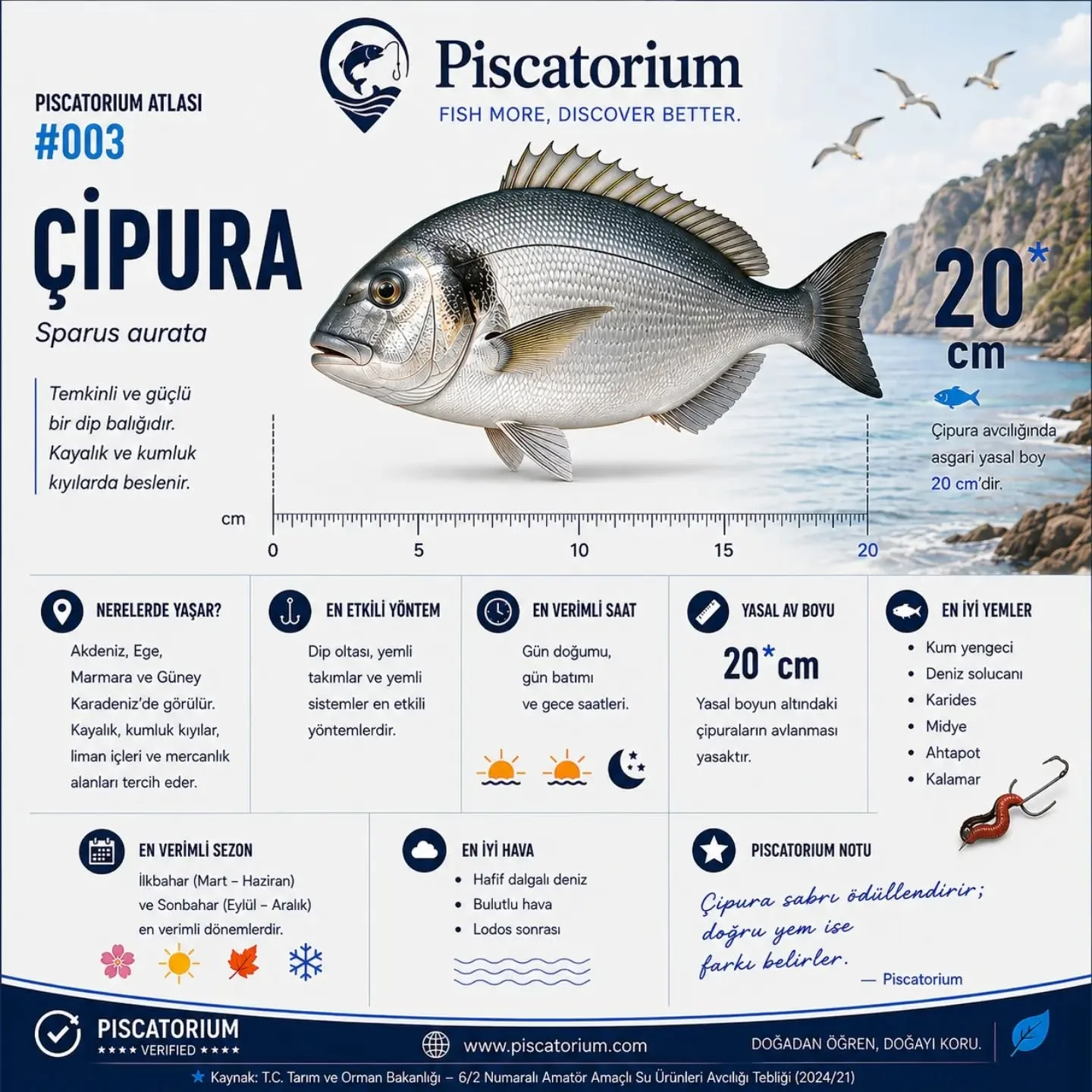
For the common pandora the minimum size is 15 cm and the daily quantity is 5 kg. The communiqué has no species-specific seasonal ban; the area and method provisions, however, apply all year. Put side by side with the limits of species from the same family that you often meet on the shore, the common pandora's limit sits at the bottom of the list:
| Species | Minimum size | Daily quantity |
|---|---|---|
| Common pandora | 15 cm | 5 kg |
| Common two-banded seabream | 18 cm | 5 kg |
| Gilthead seabream | 20 cm | 5 kg |
| White seabream | 21 cm | 5 kg |
| Common dentex | 35 cm | 5 kg |
The numbers are from the amateur fishing communiqué no. 6/2; the official communiqué is the binding one, so check the current publication before you go fishing. The limits for all species are on the legal fish sizes page, and the species whose catch is completely banned are in the article which fish are banned from fishing. The common pandora's months and baits sea by sea are on the common pandora species page.