












4 min read
Atlantic mackerel: when and how is it caught?
All year in the Black Sea, September – January in the Sea of Marmara and the Aegean. The recorded seas, bait, technique and 20 cm legal limit of the Atlantic mackerel.
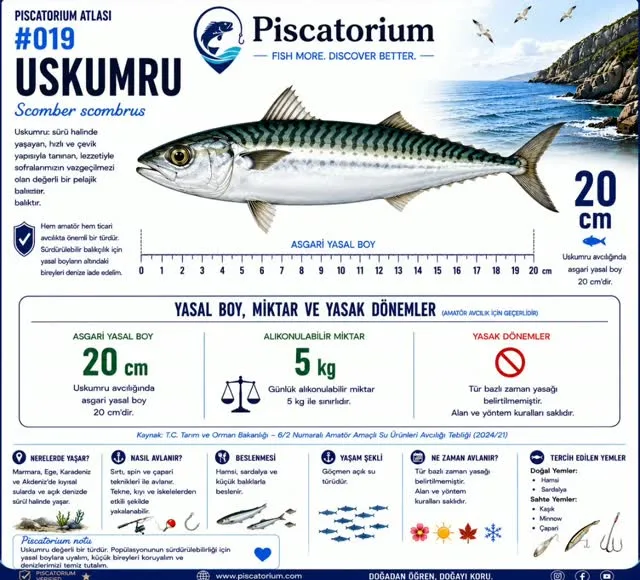
Atlantic mackerel (Scomber scombrus) is recorded in all four Turkish seas in our catalogue; it is marked as productive year-round in the Black Sea and from September to January in the Marmara and the Aegean. Its recorded natural baits are European anchovy and European sardine, its lures are spoons, minnows and sabiki rigs; the techniques that stand out are trolling, spinning and sabiki.
There is a close relative that can turn up in the same shoals, on the same rig: the Atlantic chub mackerel. The two species differ in season, legal size and appearance, so the first job of this article is to tell them apart.
Atlantic mackerel or Atlantic chub mackerel?
Both belong to the family Scombridae and to the same genus. On the Atlantic mackerel's back, dark, wavy crosswise stripes are pronounced, while its belly is a plain silvery white. On the Atlantic chub mackerel (Scomber colias) the back stripes are thinner and broken; the real difference is the dark speckles scattered over the lower half of its sides and its belly. The chub mackerel's eye is also relatively large.
Looking inside settles it: the Atlantic mackerel has no swim bladder, the Atlantic chub mackerel does. The communiqué lists the chub mackerel as Scomber japonicus; in current classification the chub mackerel of the Mediterranean and the Atlantic is separated as S. colias, but the rule covers the same fish. This distinction has a practical consequence: a 19-centimetre chub mackerel can be kept, a mackerel of the same size cannot.
Calendar: year-round in the Black Sea, autumn and early winter in the Marmara and the Aegean
| Sea | Atlantic mackerel | Atlantic chub mackerel |
|---|---|---|
| Black Sea | Recorded year-round | Recorded year-round |
| Marmara | September – January | May – October |
| Aegean | September – January | May – October |
| Mediterranean | No month data | April – September |
In the Marmara and the Aegean the two species fill each other's gaps: the chub mackerel is marked productive from late spring to October, the Atlantic mackerel from September to January. In September and October both are recorded; in these two months you need to identify the species before putting a fish in the bucket. The Mediterranean appears in the seas list for the Atlantic mackerel, but the month, bait and technique fields in that row are empty.
In our catalogue the Atlantic mackerel is marked as a migratory species, with the recorded habitat "migratory open water". General angling knowledge likewise describes it as the fish of shoals that travel back and forth between the Black Sea and the Marmara via the Bosphorus, not of a single coast. The article Bosphorus fishing covers how the current shapes this passage.
Recorded at 136 spots in the Black Sea
Spot-level records are concentrated in the Black Sea: the Atlantic mackerel is recorded at 136 fishing spots along the Black Sea coast. For the Marmara and the Aegean the species is recorded at sea level, with no spot-level count. The provinces with the most recorded spots are:
- İstanbul — 24 spots
- Kocaeli — 14 spots
- Düzce and Bartın — 13 each
- Zonguldak — 11 spots
- Sinop — 10 spots
The list starts from İstanbul's Black Sea coast and runs along the western and central Black Sea. The Atlantic chub mackerel, by contrast, is recorded at only 1 spot, also in İstanbul; compared with the Atlantic mackerel its spot-level record is very narrow. The article what you can catch in the Black Sea in October gathers which species get active in the Black Sea in autumn.
Bait: anchovy pieces, spoons, feathered sabiki
In the Marmara and Aegean rows the recorded main bait is "anchovy / spoon", that is, European anchovy as natural bait and a spoon as lure. In the Black Sea row, however, the bait is a single word: feathered sabiki. The natural bait list is the same in all three seas, European anchovy and European sardine; the regional supporting baits that vary by sea are:
- Marmara — European anchovy, Atlantic horse mackerel, shrimp
- Aegean — European sardine, mamun, sülünez
- Black Sea — European anchovy, European sprat
On the lure side, spoons, minnows and sabiki rigs are recorded. Because it is a shoal fish known for its interest in bright, fast-moving lures, speed matters as much as colour when fishing for Atlantic mackerel.
Technique: trolling, spinning and sabiki
In the Marmara and the Aegean three techniques are recorded together. Trolling means towing bait or a spoon behind a boat moving slowly. Spinning is casting and retrieving a spoon or minnow from shore or from a boat. Sabiki means working vertically with feathered hooks on short droppers strung along a main line; it is the only technique recorded in the Black Sea row.
When the shoal passes underneath, a sabiki rig can come up with several fish at once. In that case each fish has to be measured separately; the number of hooks on a sabiki is also subject to the general provisions of the communiqué.
From shore or from a boat?
In our catalogue the Atlantic mackerel's shore-fishing suitability is marked "medium". What that means: on days when the shoal comes close to shore it can be reached with spinning or sabiki from piers, breakwaters and headlands, but when the fish roam offshore your chances from shore drop quickly. A boat reduces this uncertainty; the trolling technique requires a boat anyway.
The signs anglers look at to locate a shoal are generally the same: gulls diving at the water, small baitfish boiling on the surface, shores where the current changes direction. Because the Atlantic mackerel follows small shoaling fish such as European anchovy and European sardine, the places where these shoals are seen are often places where mackerel are nearby. Once the shoal has passed, it is better to move than to insist on the same spot.
Legal size and quantity
| Species | Minimum size | Daily quantity | Closed season |
|---|---|---|---|
| Atlantic mackerel (S. scombrus) | 20 cm | 5 kg | Not specified |
| Atlantic chub mackerel (S. colias) | 18 cm | 5 kg | Not specified |
For both species the communiqué has no species-specific time ban; area and method provisions, however, apply year-round. Length is measured from the tip of the snout to the tip of the tail. With shoal fish, measuring takes speed; a centimetre line marked on the gunwale of the boat or the rim of the bucket is more practical than unrolling a tape for every fish. Releasing a fish just under the limit without wasting time improves its chance of survival. All the limits are on the legal fish sizes page; the figures come from communiqué no. 6/2 on recreational fishing, the binding text is the official communiqué, and you should check the current publication before going fishing.
Months, baits and recorded spots, sea by sea, are together on the Atlantic mackerel species page.