









5 min read
Fishing spots in İstanbul: 218 places, district by district
From Sarıyer to Şile, from Adalar to Çatalca — where you can cast from the shore in İstanbul, broken down by district and by species.
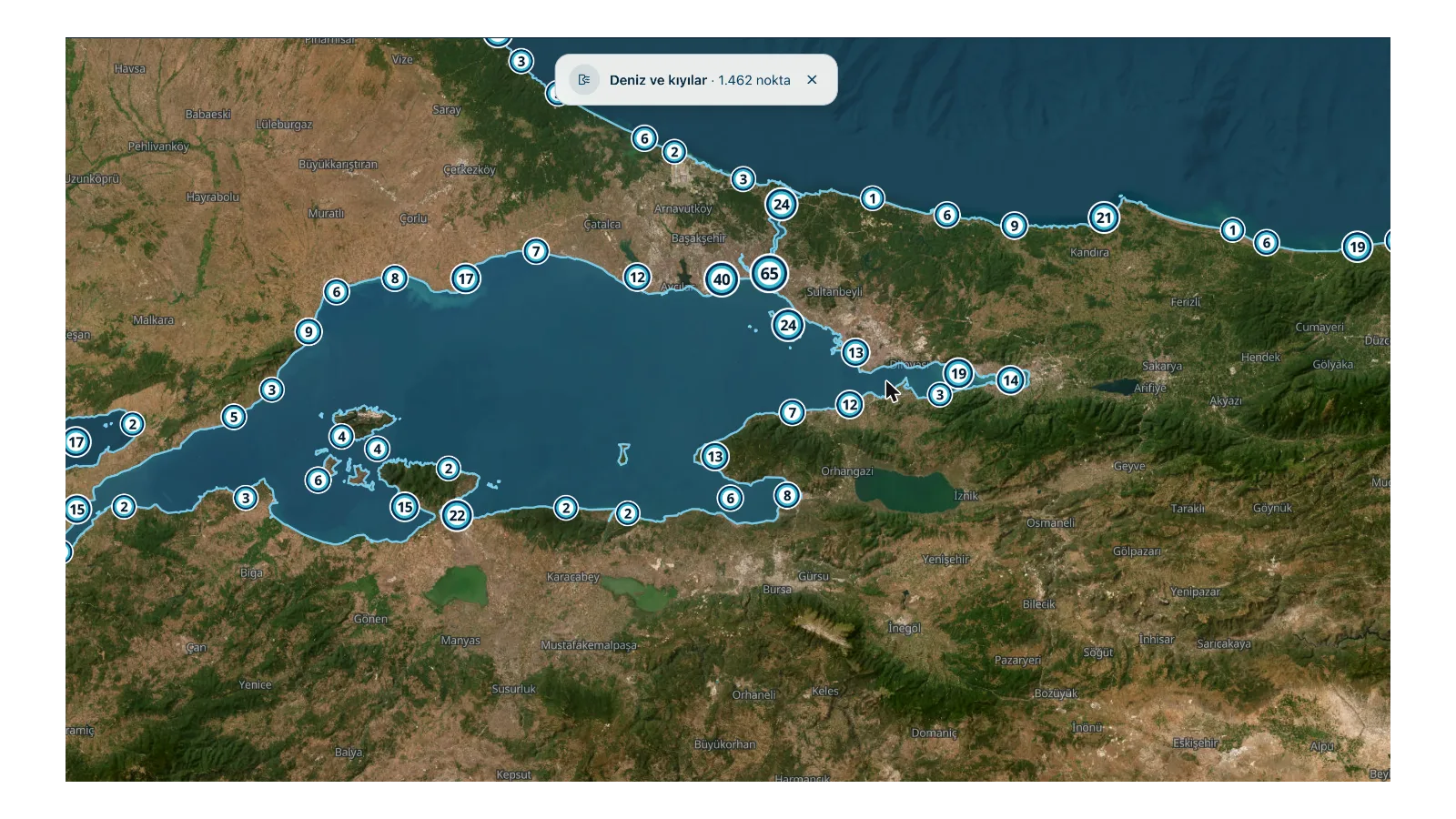
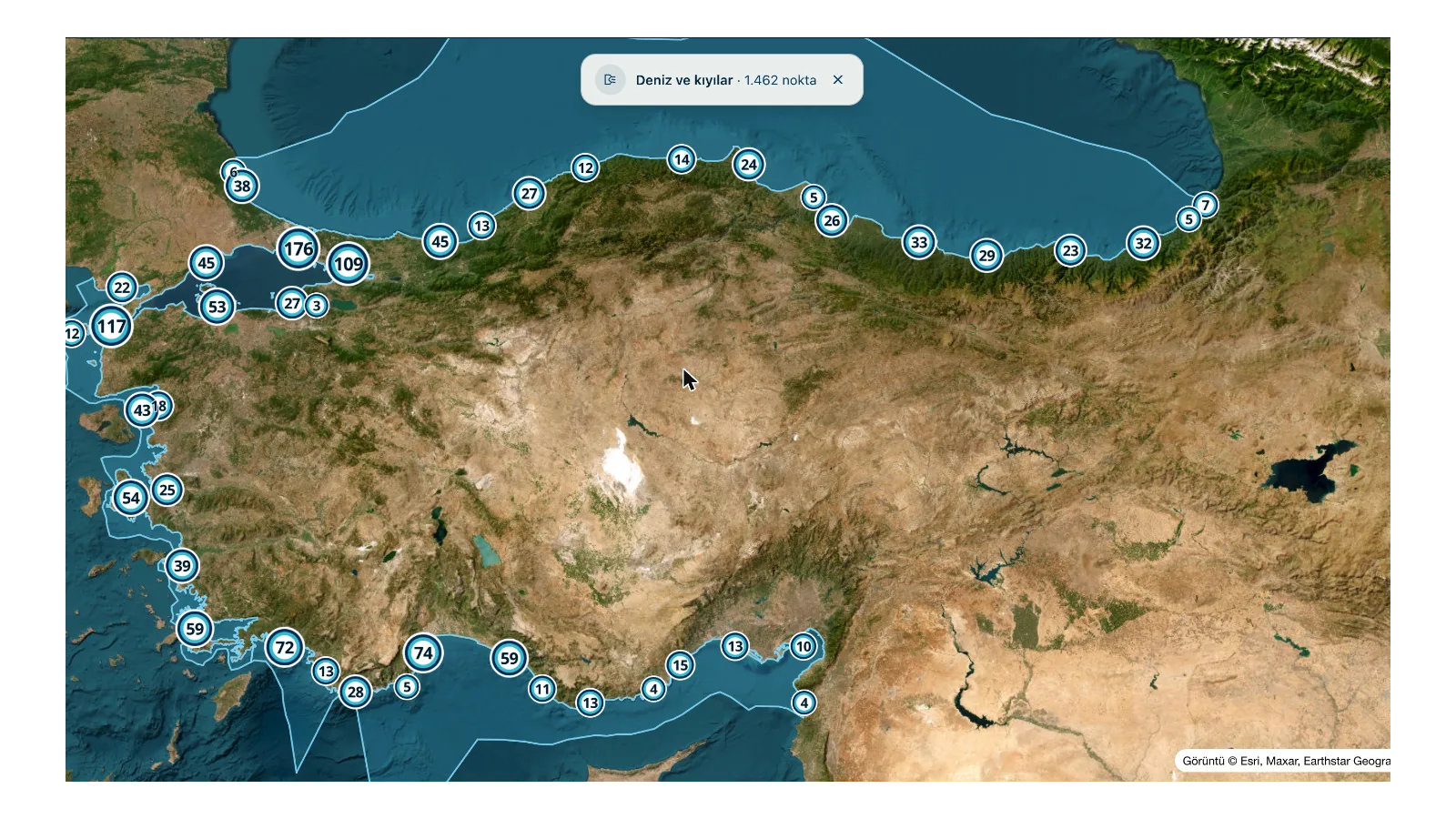
İstanbul has more fishing spots than any other province in Turkey in our catalog: 218 separate spots spread across 24 districts. Because the Bosphorus, the Marmara and the Black Sea meet in one city, you find both great fish variety and plenty of confusion here. There is no single answer to "where can you fish in İstanbul?"; the answer changes with the target fish, the season and that day's wind.
This article is not a "best spot" ranking. It shows where you can fish in İstanbul by district, coast type and sea; once you know what kind of setup a spot has, the season and the wind decide the rest.
Where can you fish in İstanbul? District by district
İstanbul's fishing spots are not evenly spread along the coast. The first eight districts hold 130 of the 218 spots, which is more than half of the total:
- Sarıyer — 23 spots. At the northern mouth of the Bosphorus the current is strong and deep water is close to shore. Rumeli Kavağı and Garipçe face the Bosphorus, while the beaches of Kilyos and Kısırkaya face the Black Sea.
- Adalar — 22 spots. Ferry piers and rocky shores on Büyükada, Heybeliada, Burgazada and Kınalıada.
- Kadıköy — 19 spots. Moda shore, the Fenerbahçe and İnciburnu lighthouses, the Caddebostan beaches and the Bostancı piers.
- Fatih — 16 spots. The historic peninsula shore running from Eminönü to Sarayburnu, and from there to Ahırkapı and Yenikapı.
- Beykoz — 13 spots. The Anatolian side of the Bosphorus: the piers of Anadolu Kavağı, Kanlıca, Çubuklu and Paşabahçe, and the mouth of the Riva Stream in the north.
- Şile — 13 spots. Black Sea beaches, the Şile and Ağva lighthouses, stream mouths; a surf casting area.
- Çatalca — 12 spots. The calm western Black Sea coast, with the beaches of Karacaköy, Evcik and Ormanlı.
- Silivri — 12 spots. Shallow, long beaches on the Marmara, with small stream mouths in between.
The remaining 88 spots are spread across sixteen districts. Beyoğlu with 11, Bakırköy with 10, Büyükçekmece with 9, and Beşiktaş and Üsküdar with 8 each lead this group.
The Bosphorus: piers and current
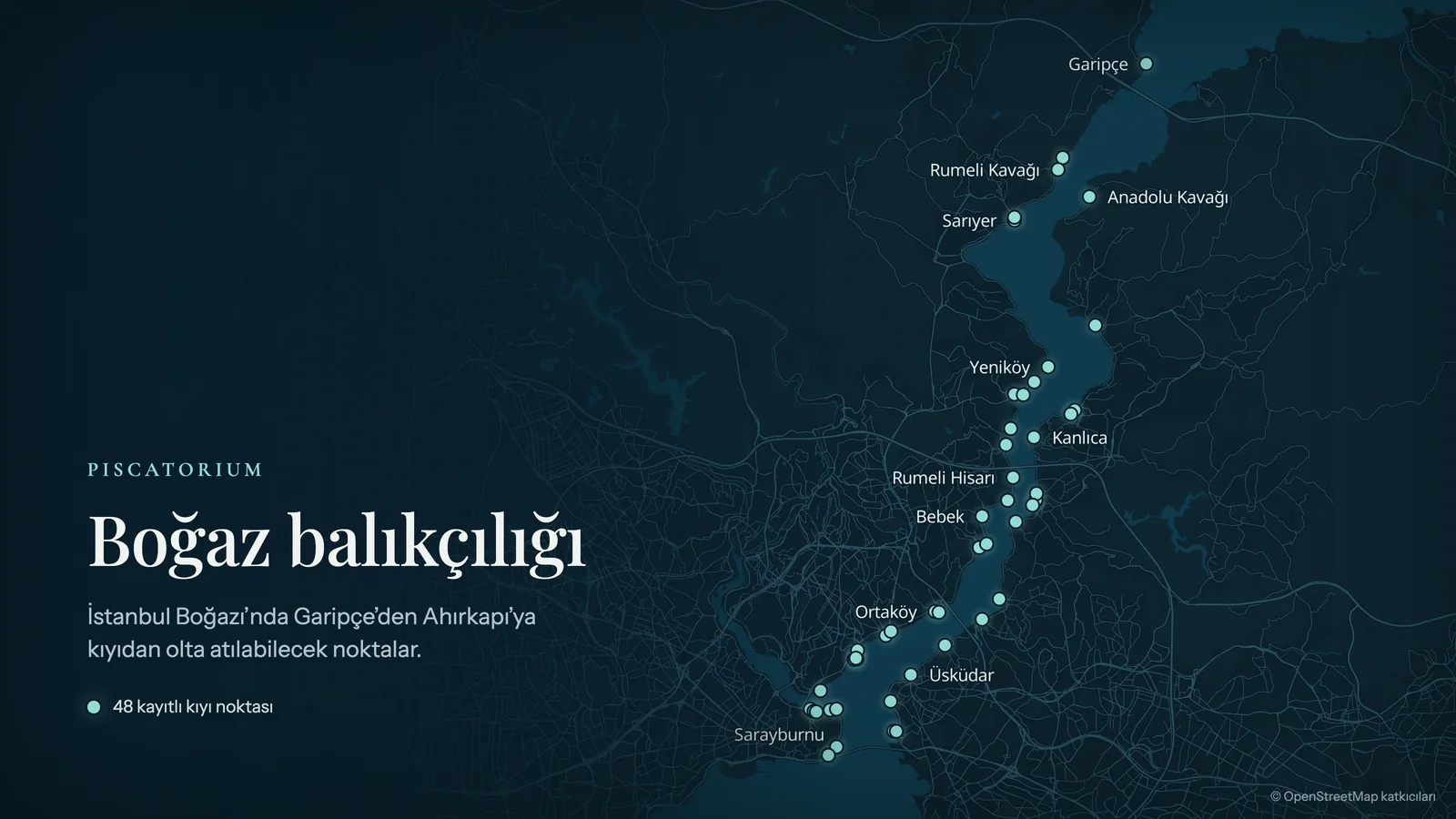
Fishing in the Bosphorus is done largely from piers and quays. On the European side Ortaköy, Arnavutköy, Bebek, İstinye and Tarabya, and on the Anatolian side Üsküdar, Kuzguncuk, Çengelköy, Kanlıca and Anadolu Kavağı are well-known stops along this line. The Eminönü and Karaköy quays at the two ends of the Galata Bridge, the city's most famous view of anglers, are also listed in our catalog as separate spots.
In the Bosphorus the current often decides the fishing before the season does. Around the capes the water squeezes and speeds up, and inside the coves it slows down; Atlantic horse mackerel and bluefish follow these passages. In autumn the Atlantic bonito and the Atlantic bonito's larger cousin, the torik, which come down from the Black Sea to the Marmara, pass through the same way. We explain how the current works and cover the 48 Bosphorus spots separately in our Bosphorus fishing article.
The Golden Horn is a different world: the piers of Balat, Fener, Ayvansaray and Eyüp, and across the water Hasköy, Sütlüce and Kasımpaşa, offer calm water sheltered from the current. On rough days when you can't get out onto the Bosphorus, it is an easy option for flathead grey mullet and Atlantic horse mackerel.
The Marmara coast: promenades, beaches and the Princes' Islands
169 of the 218 spots are on the Marmara side; the Bosphorus and the Golden Horn are included in this number. The Anatolian-side shore runs from Kadıköy through Maltepe, Kartal and Pendik to Tuzla, with its seaside parks and ferry piers. On the European side, from Bakırköy and Florya toward Avcılar, Büyükçekmece and Silivri, the shore gets shallower and the beaches grow longer.
Fishing on this coast is done with patience and light tackle. Around rocks and pier bases people look for common two-banded seabream, white seabream and annular seabream, on sandy bottom for gilthead seabream, and at stream mouths for European seabass and flathead grey mullet. The piers of the Princes' Islands (Adalar) are among the places where you reach deep water from shore by the shortest route.
The Black Sea coast: beaches and surf casting
The 49 spots on the Black Sea side are concentrated in Şile, Çatalca, Arnavutköy and the northern coast of Sarıyer. This is the region of long beaches and surf: the bait is cast beyond the line where the waves break, and the tackle gets heavier accordingly. On sandy bottom whiting, striped red mullet and turbot are the well-known fish of this coast; on rough days European seabass and bluefish come in close to shore.
Why does the spot type matter?
Two spots in the same district can be completely different; the tackle and the hour you choose for fishing also change with the coast type. This is how the spots in İstanbul break down:
- Pier / quay — 85 spots. Places where you can walk out to deep water. The most practical option for evening fishing under lights.
- Sandy beach — 52 spots. Requires long casts; the fish roam along the line where the waves break.
- River / stream mouth — 28 spots. Where fresh water mixes with the sea; classic for European seabass and flathead grey mullet, especially after rain.
- Seaside strip / promenade — 26 spots. Easy to reach, crowded on weekends.
- Cape / point — 13 spots. Where the current squeezes; predatory species pass through here.
The remaining 14 spots are of rarer types such as mixed shore, inside a cove, lagoon mouth and inside a harbor.
Which fish in which season?
You can go fishing in İstanbul in every month of the year; what changes is the target fish. Atlantic horse mackerel is recorded year-round in both the Marmara and the Black Sea and is the most usual fish on the piers. Atlantic horse mackerel, whiting and bluefish are the species that come closest to shore with autumn: Atlantic bonito is productive in the Marmara from August to December, and whiting from October to April.
Summer months are the season of picarel, Atlantic chub mackerel and red mullet; gilthead seabream and European seabass are sought year-round in the Marmara. Whatever the season, the busiest hours don't change: early morning and sunset. You also need to know which fish to put back in the water; the minimum legal size is 18 centimeters for bluefish, 25 for Atlantic bonito and European seabass, 20 for gilthead seabream, 13 for whiting and 12 for Atlantic horse mackerel (13 for Mediterranean horse mackerel).
Which tackle, which bait?
The spot decides the tackle as much as the fish does. On piers, sabiki rigs and micro jigs are enough for Atlantic horse mackerel; on the same pier in the evening hours you switch to a spinning rod for bluefish. For European seabass the recorded baits are shrimp and young mullet, with spinning still the technique. On the sandy shore of the Marmara, mussel, sandworm and crab are used for gilthead seabream. On the Black Sea beaches, surf casting is done with a long rod and heavy sinkers; light tackle can't get past the waves.
Wind: how poyraz and lodos change the shore
In İstanbul, on the same day one shore can be fine for fishing while another is closed off. Poyraz blows from the northeast; it roughens the Black Sea coast, speeds up the upper current in the Bosphorus, and often leaves the Marmara coast sheltered. Lodos does the opposite: it batters the Marmara coast and slows the Bosphorus's surface current. So on a poyraz day Kadıköy or Bakırköy, and on a lodos day the sheltered coves of the Bosphorus and the Golden Horn, are more comfortable choices. We explain what each wind brings in our which wind is good for fishing article.
Fresh water: lakes and dams
İstanbul is not only a sea coast. Our catalog also has 55 freshwater spots on the shores of Ömerli Dam, Lake Terkos (Durusu), the Büyükçekmece and Küçükçekmece lakes, Sazlıdere, the Alibey and Darlık dams, and ponds. These spots are not on the province page but in the inland waters view of the map; in inland waters both the species and the fishing rules are separate from the sea.
Before you go
Looking at three things is enough: the wind direction (is it blowing onto the shore), the closed season and the minimum legal size. The map shows the first, and the species pages show the other two.
Some spots fall inside port areas or military zones, and shore access can also be restricted at drinking-water dams; obeying the signs always comes first.