
























4 min read
Meagre: how is it caught, and what is the minimum size?
Known by two names on the Turkish coast, the meagre is recorded in all four seas in our catalog and is at its best all year round. Its minimum size is 25 cm.
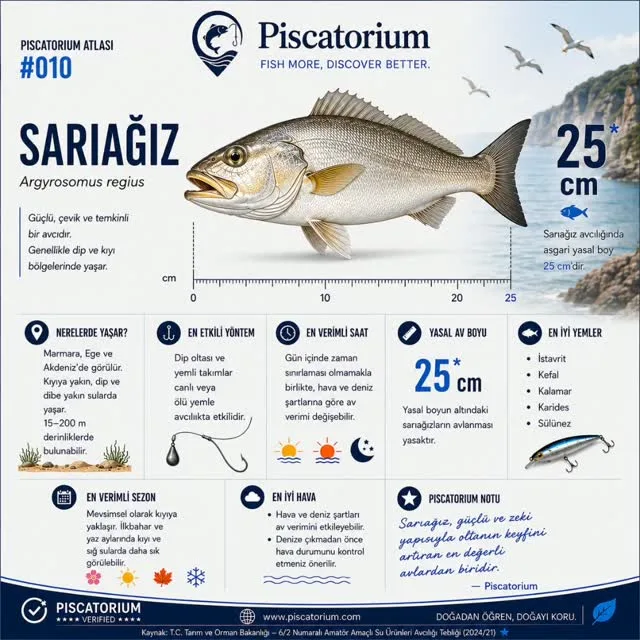
Meagre, known along the coast mostly by the name sarıağız (Argyrosomus regius); the recreational fishing communiqué lists the species under the heading “Sarıağız (Halili, Muskar, Grenyüz)”. In our catalog it is recorded in all four of the Black Sea, the Sea of Marmara, the Aegean and the Mediterranean, and its habitat is given as river mouths and sandy bottoms. The minimum legal size is 25 centimeters.
One fish, five names
Sarıağız, granyöz, grenyüz, halili and muskar are all names for the same species. In our catalog’s local names field “Sarıağız” and “Granyöz” sit together; the species page opens under the name Granyöz. Since names change from coast to coast, the only reliable marker is the scientific name: Argyrosomus regius.
The species belongs to the Sciaenidae family. Fish of this family can make sounds with their swim bladders; that is why they are known in other languages by names meaning “drummer” or “croaker”. Sarıağız is one of the large members of the family: it has a long, powerful body and a color that ranges between silvery and bronze. The feature that gives it its name is the yellowish color inside the mouth and the gill cover. Its lateral line also extends into the tail fin, which makes it easier to recognize on the shore.
Which species is it confused with?
Two fish from the same family are often mistaken for sarıağız. Shi drum has a single short barbel under its chin and slanting, wavy lines on its body. Brown meagre is dark bronze; its pelvic and anal fins are dark, with a light-colored stripe along the leading edges. In our catalog the habitat of brown meagre is given as rocky coast, and that of sarıağız as sandy bottoms and river mouths.
Telling them apart is not just a matter of names, because the limits for the three species differ. The minimum size is 25 for sarıağız, 35 for brown meagre and 45 centimeters for shi drum; for brown meagre, at most 3 fish per day may also be kept. Putting a shi drum in your bucket thinking it is a sarıağız means breaking the 45-centimeter limit without realizing it.
Where is it recorded along the Turkish coast?
In our catalog, meagre is linked to a total of 374 spots along the Turkish coast. The distribution is uneven: the Black Sea has 169 spots, far ahead, followed by the Sea of Marmara with 94, the Aegean with 58 and the Mediterranean with 53. These numbers show not how plentiful the fish is at a spot but at how many spots it has a record; in other words, they measure how widespread it is, not a guarantee of a catch. Our catalog rates the species’ catchability from the shore as “medium”: a fish you can reach from the beach and from river mouths, but not one to expect at the end of every pier.
In the ranking by province, İstanbul is at the top with 35 spots. It is followed by Çanakkale with 33, Balıkesir with 29, Antalya with 28, Samsun with 24 and İzmir with 19. Samsun’s presence on the list fits the species’ recorded habitat: the Kızılırmak and the Yeşilırmak flow into the sea on this coast, and sarıağız is a fish that approaches the mouths where fresh water mixes with salt. For an overview of the coast you can look at the Black Sea page.
When should you look for it?
In the sea-by-sea monthly data, all twelve months are marked in all four seas, so meagre is recorded year-round. According to the catalog, there is no expected opening month for this species.
The picture anglers describe is a bit more detailed. On the shore, sarıağız is mostly associated with the transitions of spring and autumn, and with river mouths that turn muddy after rain. This framework comes not from the catalog’s monthly data but from general fishing knowledge; within the same week, two shores can give completely different results.
Bait and technique records
The species record lists European squid, common cuttlefish and live flathead grey mullet as natural bait, and large soft plastics and minnows as lures. There are three headings in the fishing technique field: surf, spin and bottom fishing. Going down to the sea rows, in all four seas the technique is surf casting, and the standout bait is sülünez (sandworm).
Regional supporting baits vary by coast. The Sea of Marmara row lists anchovy, horse mackerel and shrimp; the Aegean lists sardine, mamun and sülünez; the Mediterranean lists sardine, squid and shrimp. The Black Sea row has only the technique and sülünez, and its natural bait and lure fields are empty. If you are heading there, the list in your hand is that of the other three seas.
Sarıağız is a large and powerful fish, and the tackle is set up accordingly. An angler surf casting from the beach works with a long rod, a sturdy main line and a thick leader; the bait needs to sit on the bottom, in the lane carried by the waves and current. On the spin side, large soft plastics and minnows are retrieved slowly, close to the bottom. Dusk and night are the hours shore anglers talk about most for this species; the moments when the water has not yet settled the day after a rough day also come up often in those conversations.
If you are going to use live flathead grey mullet, keep one rule in mind: mullet has its own minimum size too. It is 30 centimeters for the true flathead grey mullet and 20 centimeters for the other mullet species, and an undersized fish cannot be kept even for use as bait. The details are on the mullet page.
Legal size, quantity and season
| Species | Minimum size | Daily limit | Closed season |
|---|---|---|---|
| Sarıağız (meagre) | 25 cm | 5 kg | — |
| Brown meagre | 35 cm | 3 fish | — |
| Shi drum | 45 cm | 5 kg | — |
Basis: recreational fishing communiqué no. 6/2, 2024/21 Table 7. No species-specific closed season is defined for sarıağız; area and method provisions apply separately. Quantities are calculated per person and per day. The table is a summary: the official communiqué is what is binding, so check the current publication before you go fishing. The limits for all species are together on the legal fish sizes page.
It is hard to judge 25 centimeters by eye. Carrying a tape measure with you removes any doubt about a fish close to the limit; a fish you cannot be sure about goes back in the water. You can find how the measurement is taken from the tip of the nose to the tip of the tail, and why the limit was set, in the post what is the legal size.
What is on the species page?
The species profile, the sea-by-sea monthly table and the bait records sit together on the meagre species page. The page shows the rule according to the region you are in; the limit you read for the Turkish coast is the communiqué row above.